Icon about-block-ico-1 Icon about-block-ico-2 Icon about-block-ico-3 Icon about-block-ico-4 Icon announcement-close Icon arrow-left Icon arrow-right Icon arrow-sm Icon asterisk Icon banner-transparent-vector Icon btn-callback-ico Icon careers-item-location Icon careers-item-time Icon careers-item-type Icon careers-mail-ico Icon careers-phone-ico Icon careers-search-ico Icon careers-single-hero-vector Icon careers-single-more-vector Icon careers-vector Icon check Icon close Icon dfm-image-left-vector Icon dfm-image-right-vector Icon document Icon download-popup-vector Icon dropdown Icon envelope Icon facebook Icon faq-banner-bg Icon faq-title-ico-active Icon faq-title-ico Icon featured-links-block-bg Icon figure-1 Icon figure-10 Icon figure-11 Icon figure-12 Icon figure-13 Icon figure-14 Icon figure-15 Icon figure-2 Icon figure-3 Icon figure-4 Icon figure-5 Icon figure-6 Icon figure-7 Icon figure-8 Icon figure-9 Icon file-upload Icon form-sidebar-back Icon form-step-done Icon gmap-marker-group-icon Icon gmap-marker-icon Icon header-profile-ico Icon instagram Icon link Icon linkedin Icon loader Icon mail Icon phone Icon play-yt Icon play Icon post-nav-arr-left Icon quote-banner-vector Icon quote-block-aside-vector Icon quote-contact-phone-ico Icon quote-contact-position-ico Icon sidebar-location Icon sidebar-phone Icon technology-banner-nav-left-vector Icon technology-banner-nav-right-vector Icon twitter Icon webinar-item-date-vector Icon whitepaper-img-ico-left Icon whitepaper-img-ico-right Icon whitepapers-listing-banner-ico Icon whitepapers-single-aside-vector Icon youtube Icon yt-play-button

Why Is Robotic Gear Essential for Industrial Automation?

Industrial automation is often pictured as sensors, controllers, and robotic arms. Yet motion depends on the components connecting a motor to its load. Robotic Gear systems, including gearboxes and precision reducers, help control speed, torque, and positioning. In a packaging cell, for example, a robot may need to place a small part repeatedly without shaking or drifting. The drive system influences how smoothly that movement happens.

Gear selection affects more than speed. Engineers consider load, duty cycle, required accuracy, mounting space, noise, and maintenance access. A reducer that suits a light pick-and-place task may not withstand a heavy palletizing cycle. Backlash, heat, lubrication, and wear also deserve attention. Small details matter. A poorly matched unit can raise energy use, shorten service life, or cause inconsistent motion. The exact outcome depends on the machine and how it is operated.

Robotic Gear is therefore an important part of automation, but it is not a cure-all. Proper sizing and installation matter, as do routine inspection and clear manufacturer specifications. Teams should compare operating requirements with verified performance data rather than choose by price or headline torque alone. Even then, selection is not always tidy; real production conditions can differ from the design assumptions. That deserves a second look. This guide explores why gearing matters, which factors shape selection, and where its limits should be considered.
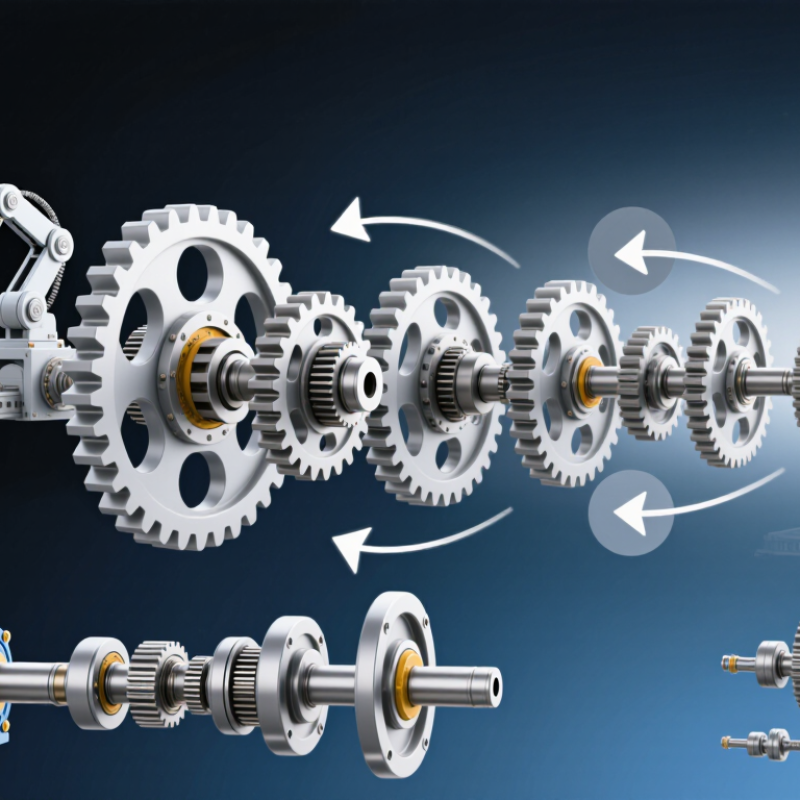
Why Is Robotic Gear Essential for Industrial Automation?

What Robotic Gear Includes in Industrial Automation

Robotic gear in industrial automation includes more than the robot arm itself. It combines mechanical, electrical, and control equipment that lets a machine perform repeatable tasks. The arm provides reach and movement, while joints and drive systems control its position and speed. Gearboxes or reducers can increase torque and improve control, especially when handling heavier parts. Small details matter.

The end effector is the tool attached to the arm. It may be a vacuum cup for lifting cartons, a gripper for holding metal components, or a welding tool for joining parts. Sensors help the robot locate objects and check whether a grip is secure. Controllers translate programmed instructions into movement, while cables and connectors carry power and signals. A fixture may hold a workpiece steady during assembly or inspection.

The surrounding equipment is part of the setup, too. Safety scanners, guards, and emergency stops help manage access around moving machinery. Conveyors and feeders bring parts into reach, and human-machine interfaces let operators adjust settings or review faults. In practice, selecting compatible components can be harder than choosing the arm. A sensor may work well on clean parts but struggle with glare, dust, or changing light. Those conditions deserve testing before the cell goes into regular production.

How Robotic Gear Enables Precise and Repeatable Tasks

Robotic gear helps an industrial robot move with controlled speed and usable force. A gear reducer can turn a fast motor rotation into slower motion at the joint. This matters when a gripper must place a small metal part into a narrow fixture, again and again. Low backlash helps the arm reach the same position with less lost motion. Still, the gear alone cannot guarantee accuracy. Calibration, mounting stiffness, and changes in temperature also affect results.

Tips: Check for unusual vibration, heat, or rising noise during routine inspections. Keep a record of positioning errors; small changes may reveal wear before they disrupt a production cycle.

Repeatability depends on the whole motion system. A well-matched gear set, motor, and controller can help maintain consistent paths across long shifts. For example, a robot applying sealant needs steady joint motion to keep the bead even around corners. If a joint hesitates, the line may become thicker in one spot. Operators can compare test positions and review maintenance logs to spot that drift. In practice, perfect consistency is not always realistic. Loads change, parts vary, and even a careful setup may need adjustment. The useful goal is to detect those differences early and keep task quality within defined limits.

How Robotic Gear Improves Productivity and Workplace Safety

In a busy assembly cell, robotic gear can repeat lifting, fastening, or machine tending with steady timing. A robot placing metal housings onto a conveyor, for example, reduces pauses between cycles and keeps parts moving at a predictable pace. Less repetitive handling can also reduce fatigue, especially during long shifts. Small gains add up.

Productivity depends on good integration, not just speed. Sensors, grippers, and control settings must match the part and task. If a component arrives crooked, the robot may stop or handle it incorrectly. A robot can also expose weak process design rather than fix it. Not magic. Operators need training to recognize faults, reset equipment safely, and report unusual movement.

Robotic gear can improve workplace safety by taking people away from hot surfaces, sharp edges, heavy loads, or repetitive awkward reaches. Physical barriers, interlocks, and clearly defined work zones help reduce contact risks, but they do not remove every hazard. Teams should assess the cell layout and keep emergency stops accessible. Maintenance matters, too: a worn cable or loose fixture can cause unexpected downtime or unsafe behavior. Productivity and protection improve most when workers help plan the system and review how it performs in real shifts.

Where Robotic Gear Fits in Automated Production Systems

In automated production systems, robotic gear connects motors to joints, conveyors, grippers, and positioning tables. It controls how force and speed reach each moving part. A reducer can help a robot lift a heavy casting slowly, while a precise drive can guide a small component into a fixture. Without the right gearing, motors may struggle with sudden loads, positioning can drift, and cycle times may become inconsistent.

Gear selection depends on the task, not just the robot’s rated payload. Engineers consider torque, speed, backlash, duty cycle, mounting space, and exposure to dust or washdown. A mismatch can cause heat, vibration, or early wear. Small details matter.

Tips: Check the load at the tool, not only at the arm. Include grippers and cables in the estimate. Then test repeated starts and stops under realistic conditions.

Gear also shapes how separate stations work together. A conveyor gearbox must keep parts moving at a predictable rate, while a robot’s joint drives need repeatable motion near its work area. During commissioning, teams can compare commanded positions with measured results and inspect temperature or noise after sustained operation. One awkward reality: calculations rarely capture every production variation. A sample part may sit slightly crooked, or friction may change with wear. Leave room for adjustment, and document the settings that work.

Why Robotic Gear Is Essential for Industrial Automation

Typical reduction-ratio ranges show how different gear types support robotic joints and other automated motion systems.

Gear reducers trade speed for torque and help control motion at robot joints, positioning axes, and automated production equipment. Ranges are representative engineering examples; actual specifications vary by design.

What to Consider When Selecting Robotic Gear

Selecting robotic gear starts with motion requirements, not catalog dimensions. Define payload, reach, cycle time, and the fastest required move. A compact joint may save space, yet still need high torque during acceleration. Check output torque, allowable speed, and reflected inertia across the full motion profile. Small mistakes matter. Evaluate the motor, reducer, and end effector as one system.

Match gearbox ratings to real operating conditions, not peak figures alone. A pick-and-place arm may reverse direction hundreds of times per shift. Account for acceleration, braking, and payload changes; these can increase loads beyond steady operation. Then inspect backlash and torsional stiffness. Excessive backlash can leave a gripper slightly off target, even when the controller is well tuned. No gearbox is perfectly rigid.

Plant conditions shape the choice too. Dust, washdown, heat, and vibration affect sealing, lubrication, and service life. Ask how lubrication is maintained and whether routine inspection requires dismantling nearby equipment. Verify mounting dimensions, shaft interfaces, and cable clearance before ordering. A quiet trial run helps, but it cannot reproduce every production shift. It is tempting to choose the smallest, lightest option; that trade-off deserves a careful second look.

Why Is Robotic Gear Essential for Industrial Automation? - What to Consider When Selecting Robotic Gear

Robotic gearing matches a motor’s speed and torque to the needs of a robot joint or mechanism. Characteristics vary by design and manufacturer; verify performance against the specific application and operating conditions.

Gear type Why it matters in automation Typical strengths Trade-offs to consider Selection checks
Planetary Commonly used where a compact drive must deliver increased output torque and reduced speed. Coaxial layout; load shared among multiple planet gears; available in configurations for a range of ratios and loads. Backlash, efficiency, noise, and service life depend on the design, precision, lubrication, and load. Rated and peak torque, ratio, backlash, thermal limits, mounting, and duty cycle.
Strain-wave (harmonic) Can provide high reduction in a compact package, useful in space-constrained robot joints. High single-stage reduction ratios are possible; precision versions can have very low backlash. Flexspline fatigue, torsional stiffness, efficiency, and tolerance of shock or overload require attention. Repeated acceleration, peak torque, stiffness, backlash specification, and expected service life.
Cycloidal Often considered for joints exposed to substantial loads or impact, such as some industrial robot axes. Multiple contact points can support high torque capacity; some designs offer low backlash and good shock resistance. Size, mass, vibration, and running smoothness vary with design and may affect fast, precise motion. Impact loads, output bearing capacity, speed range, vibration, backlash, and mounting orientation.
Spur or helical Suitable for many transmission stages and mechanisms where gear geometry and packaging allow. Well-established gear forms; helical teeth generally engage more gradually than spur teeth. Helical gears generate axial thrust; noise, backlash, and efficiency depend on quality, alignment, and lubrication. Gear ratio, tooth quality, alignment, bearing support, lubrication, noise, and allowable backlash.
Worm Can provide substantial speed reduction in a compact, right-angle arrangement. Right-angle shaft layout; some ratios and configurations may resist back-driving. Sliding contact can cause heat and lower efficiency than some other gear types; self-locking is not guaranteed. Efficiency, heat dissipation, lubrication, back-driving behavior, and continuous-duty rating.

Key selection factors

Factor What to assess Why it affects the choice
Load and torque Continuous torque, peak torque, payload, inertia, and acceleration or deceleration loads. A gear unit must handle the real operating loads, not just the nominal payload.
Precision and stiffness Backlash, lost motion, torsional stiffness, repeatability, and positioning requirements. These characteristics influence positioning accuracy and response under changing loads.
Speed and duty cycle Input speed, output speed, cycle frequency, operating hours, and time spent at high load. Speed and repeated cycling affect heat generation, lubrication needs, and expected service life.
Environment and integration Available space, mass limits, temperature, dust or moisture exposure, mounting, and maintenance access. Packaging and environmental conditions determine whether a gear unit can be installed and operated reliably.

Article Source:

MSIRobot