
Why Choose a Machine Safety Door for Your Facility?
A fast production line can look controlled until a worker reaches toward a jammed part. A machine safety door helps create a physical boundary between people and hazardous motion. Its value is practical: it can limit access during operation while allowing planned inspection, loading, and maintenance. But a door alone is not a complete safety strategy.
Safety scholar Sidney Dekker’s principle is often expressed as, “Safety is the presence of capacities.” Applied to machinery, that means more than installing a barrier. The door must suit the machine, the task, and the way people actually work. Interlocks, hinges, handles, visibility panels, and stopping behavior all deserve careful review. Small details matter. A poorly positioned handle or an awkward opening can invite workarounds. That possibility is easy to overlook.
A well-selected Machine Safety Door can support safer routines and clearer separation around moving equipment. It may also reduce accidental access when paired with appropriate controls and regular checks. Still, no door can compensate for weak procedures, poor maintenance, or an unsuitable risk assessment. That is the uncomfortable part. Facilities should have a competent machinery-safety professional assess the hazards, confirm the design, and verify the installed system. Operators should be able to use the door without fighting it. The best choice is not always the heaviest or most elaborate model; it is the one that fits the real job and remains dependable over time.
What a Machine Safety Door Is and How It Works
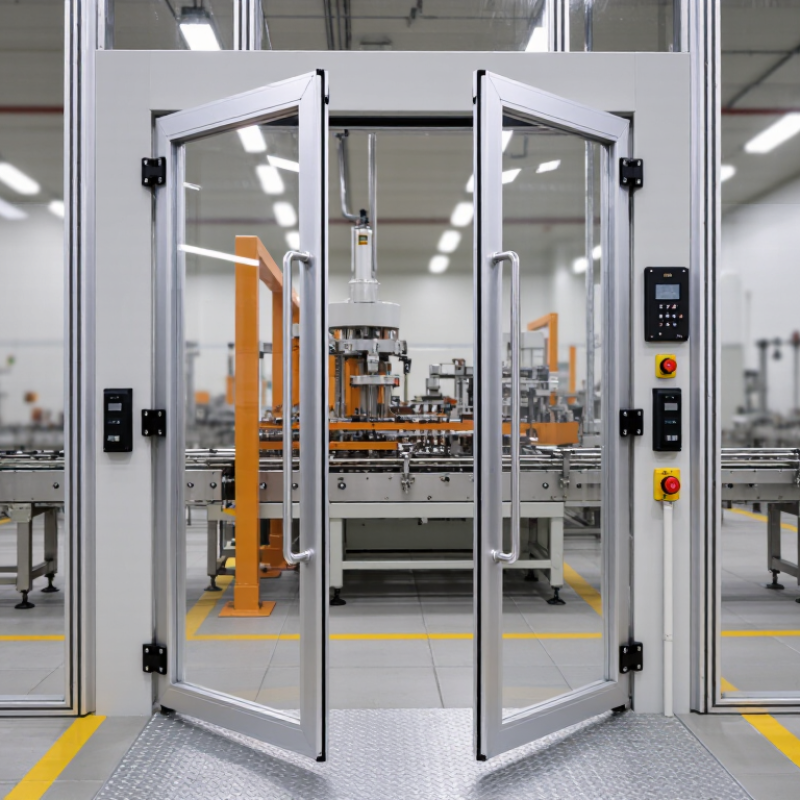
A machine safety door is a physical barrier around moving equipment, such as a sliding steel panel beside a press or a hinged enclosure around a robot cell. Its purpose is to keep people away from hazards during operation. An interlock links the door to the machine’s control system. If the door opens, the system prevents a cycle from starting or commands hazardous movement to stop. Where a machine takes time to coast down, a guard-locking device can keep the door shut until a monitored safe condition is reached. The details matter.
BLS recorded 738 fatal work injuries involving contact with objects and equipment in its 2023 Census of Fatal Occupational Injuries. This broad category includes more than machine incidents, but it shows why access to moving equipment deserves careful attention. BLS also counted 2.6 million nonfatal workplace injuries and illnesses in private industry in its 2023 Survey of Occupational Injuries and Illnesses; that figure is broad, too. A safety door is not a complete safety system. Its interlock, stopping time, and placement must suit the actual machine and task. A door that is easy to bypass, or opens before motion stops, can create false confidence. That deserves a second look.