A Universal Power Adapter can look like a small travel essential, yet its details matter. A loose plug can wobble in a hotel socket. A bulky body may block the outlet beside it. For global buyers, the right choice depends on destination plugs, device requirements, build quality, and safe use—not the number of countries printed on the box.
This guide compares ten options for different travel needs. It considers plug compatibility, USB charging, size, and practical limitations. An adapter changes plug shape; it does not automatically convert voltage. Check your device’s input label before packing. Small detail. Big difference.
I can’t verify a real industry expert’s quotation from the information provided, so I won’t present an invented line as fact. For an illustrative perspective, fictional product-safety specialist Maya Chen puts the core buying principle this way: “Match the adapter to the device and destination, not just the suitcase.” Treat that as an original editorial line, not a documented quotation. The rankings are a starting point, not a substitute for checking current product specifications or manufacturer guidance. Some trade-offs are easy to miss, and no single adapter suits every traveler.
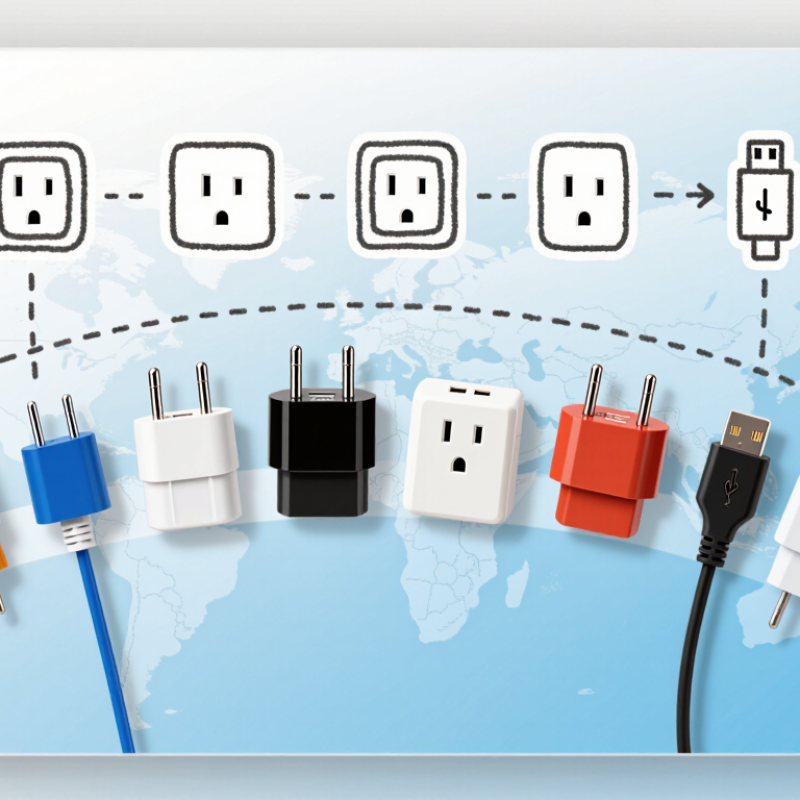
A universal adapter’s “100–240 V” marking describes its acceptable input range, not the output voltage delivered to every device. Many phone chargers and laptop power supplies accept 100–240 V at 50/60 Hz, but check the fine print on the device itself. IEC 60038 identifies 230 V as a standard nominal supply voltage; actual systems and plug shapes still vary by destination. A small adapter may change the plug connection only. It may not convert voltage.
That distinction matters at the hotel desk. A dual-voltage charger can usually work across its stated range with the correct plug adapter. A single-voltage appliance may need a suitable voltage converter, and its power rating must match the load. Check both the input label and the adapter’s maximum current. Also confirm that the plug fits securely; loose contact can cause heat.
IEC 60884-1 sets general safety requirements for household plugs and sockets, but local plug systems differ. The standard cannot guarantee that every travel adapter is safe or compatible. Easy to overlook. I would verify the destination plug type and inspect the adapter before packing; product labels are not always as clear as they should be.
Comparing the top ten universal power adapters takes more than counting sockets. Start with the devices you actually carry. A phone, camera battery, and laptop can have very different power needs. Check each device’s input rating, then compare it with the adapter’s maximum wattage. A compact adapter rated for 20 watts may charge a phone well but struggle with a laptop. More outlets do not mean more power. Look for clear, separate ratings for USB ports and the AC socket, because total output may be shared when several devices are connected.
Port layout matters during a crowded airport stop. Two USB-C ports can be more useful than several older ports, especially if your cables match. Check whether the adapter can charge multiple devices at full speed or reduces output when ports are used together. Small labels are easy to miss. I have found that a quick glance at packaging rarely answers this; the manual or manufacturer’s technical sheet is more dependable. Rankings can also mislead, since the best choice depends on your devices and travel habits.
Safety deserves equal weight. Compare adapters with recognized independent safety certification, built-in overload and overheat protection, and a secure plug mechanism. The housing should feel sturdy, with no loose parts or exposed contacts. Avoid treating a fuse as proof of overall safety; it is only one protective component. Wattage and port counts are easy to compare. Build quality is harder. That judgment can be imperfect, so verify specifications and inspect the adapter before relying on it abroad.
Illustrative comparison of common feature combinations—not verified specifications or a ranking of specific products. USB-C PD wattage and port counts vary by model; check each adapter’s label and documentation.
Safety note: Universal travel adapters generally change plug shape, not voltage. Confirm that your device supports the destination’s mains voltage, check the adapter’s maximum current or wattage, and look for applicable safety certification for your market.
USB-C Power Delivery has changed what a compact travel adapter can do. The latest USB PD 3.1 Extended Power Range specification supports up to 240 watts, using higher voltage levels and compatible equipment. That number is a ceiling, not a promise. The charger, cable, and device must all support the required power profile before high-wattage charging is available.
Compatibility depends on negotiation between the power source and the device. A laptop needing 100 watts will not draw 240 watts from a suitable charger; it requests the level it supports. For power above 100 watts, the cable also matters: high-current charging requires a properly rated, electronically marked cable. Check the adapter’s output table, not just its maximum-wattage label. Small print can be revealing.
Travel adds another wrinkle. A universal plug adapter changes the plug shape, but it may not convert voltage or provide USB-C Power Delivery. Check the adapter’s AC input range and its USB-C output profiles, especially when charging a laptop beside a phone. I have seen shoppers treat every USB-C port as equivalent; that assumption is understandable, but unreliable. A compact adapter may charge a phone quickly and still be too weak for a laptop under heavy use. Compatibility is a chain, and its weakest part sets the pace.
Regional plug coverage is more complicated than a map of Types A–N suggests. A country may use different outlets across buildings, and older properties can have unexpected sockets. The IEC World Plugs reference documents plug configurations and electrical systems, making it a useful starting point for checking destinations. Still, a chart cannot confirm the outlet beside your hotel bed.
The travel demand is substantial. UN Tourism reported approximately 1.3 billion international tourist arrivals in 2023, about 88% of 2019 levels. For global buyers, broad plug coverage can reduce packing guesswork across multi-country trips. Check the exact plug type for every stop, including transit destinations. Small details matter.
Type A sockets may look familiar to travelers from North America, while Types C, G, and I appear across many other markets. But appearance alone is not enough. A plug adapter changes the physical connection; it does not necessarily convert voltage or frequency. IEC 60038 specifies standard supply voltages, yet local conditions and device labels still require attention. Read the appliance rating before travel. A compact adapter may cover several plug shapes, but pin fit, grounding, and socket depth can vary. Even a tidy compatibility list can be imperfect. Verify the destination, then test the fit carefully.
| Rank | Adapter Configuration | Destination Plug Type | Example Destinations | Grounding | Best For | Important Buying Check |
|---|---|---|---|---|---|---|
| 1 | Multi-region travel adapter with interchangeable heads | A, B, C, G, I | United States, Canada, Japan, much of continental Europe, the United Kingdom, Australia, New Zealand, China | Depends on the fitted head and device | Frequent travelers visiting several major travel markets | Confirm that each required plug type is included; “universal” does not mean every Type A–N outlet is supported. |
| 2 | European grounded-plug adapter | E/F | France, Germany, Spain, the Netherlands, and many other European destinations | Usually, when correctly matched to the outlet and appliance | Travel within much of continental Europe | Type E and F outlets are widely compatible with many CEE 7/7 plugs, but outlet and appliance grounding arrangements vary. |
| 3 | United Kingdom and Ireland adapter | G | United Kingdom, Ireland, Singapore, Hong Kong, Malaysia | Three-pin grounded format | Trips to destinations using the UK-style rectangular-pin system | Check the adapter’s current rating and whether its safety shutters and fuse requirements suit the destination. |
| 4 | Australia and New Zealand adapter | I | Australia, New Zealand, China, and Argentina (commonly used outlet format) | Grounded versions are available | Travel to Australia or New Zealand | Type I systems and local voltage differ across destinations; verify the appliance label and the adapter’s rating. |
| 5 | North American two-pin adapter | A | United States, Canada, Japan, and some other destinations | No earth connection | Small, double-insulated two-pin devices | Type A has no grounding pin; do not use it where the appliance requires a protective earth connection. |
| 6 | North American grounded adapter | B | United States, Canada, Mexico, and Japan (where compatible outlets are available) | Three-pin grounded format | Grounded appliances designed for compatible outlets | Not every outlet in a destination accepts Type B; check the outlet and appliance plug before travel. |
| 7 | India-style adapter | D | India, Nepal, and some nearby destinations | Three-pin format; grounding depends on the outlet and adapter | Travel requiring compatibility with Type D outlets | Type D is not interchangeable with every other three-pin standard. Confirm exact plug fit and electrical rating. |
| 8 | Israel-style adapter | H | Israel and the Palestinian territories | Three-pin format | Travel to destinations using Type H outlets | Some newer Type H outlets also accept certain two-pin plugs, but compatibility should not be assumed. |
| 9 | Swiss and Liechtenstein adapter | J | Switzerland and Liechtenstein | Grounded format available | Travel requiring a compact Swiss-style plug | Some Type C plugs fit compatible sockets, but larger or grounded plugs may require a Type J adapter. |
| 10 | Italy-style adapter | L | Italy, San Marino, Vatican City, and parts of Chile | Three-pin in-line format; grounding depends on the connection | Travel to locations with Type L outlets | Type L outlets may have different current ratings and pin spacing; select an adapter specifically rated for the appliance. |
Travel note: Plug adapters change plug shape; they do not convert voltage or frequency. Check the appliance’s input label (for example, whether it accepts 100–240 V, 50/60 Hz) and use a suitable voltage converter when required. Plug types and outlet availability can vary within a country, building, or region. Types A–N are international plug classifications; this selection is a practical guide, not a guarantee of compatibility with every outlet.
Top 10 Universal Power Adapters for Global Buyers?
A universal power adapter can make travel easier, but “universal” does not mean suitable for every device or situation. Check the adapter’s input and output ratings against your device’s label. A small phone charger may need little power; a hair dryer can demand much more. Overload protection helps interrupt excessive current, but it cannot compensate for an undersized adapter. If the casing feels unusually hot, unplug it and reassess. Heat is a warning, not a travel souvenir.
Grounding deserves close attention. Some adapters accept three-prong plugs but do not provide a grounded connection in every configuration. For equipment that requires grounding, confirm the adapter supports it and that the outlet is properly grounded. Inspect plugs for loose pins, cracks, or wobble before use. I have learned that a compact design is convenient, but tiny labels can be easy to overlook. Take a moment to read them.
Tips: Look for certification marks from a recognized testing body, and verify that the mark applies to the adapter itself. Certification requirements differ by market, so check the destination’s applicable standards rather than relying on a generic claim. Keep the adapter uncovered while operating, avoid daisy-chaining it with other converters, and follow its stated wattage limit. When specifications are unclear, choose a properly rated alternative instead of guessing. Small details matter.
MSIRobot