
Top 10 Best Wood Chippers for Sale in 2026
A dependable Wood Chipper should turn real yard waste into manageable chips—not create a new safety or maintenance problem. The need is substantial. The U.S. Environmental Protection Agency’s 2018 Advancing Sustainable Materials Management report estimated that Americans generated 35.4 million tons of yard trimmings. About 22.3 million tons were composted or mulched. Those figures help explain why homeowners, landscapers, and property managers compare chippers for cleanup and material processing.
This 2026 guide evaluates ten Wood Chipper models by practical buying factors: branch capacity, power source, feed design, portability, maintenance, and available safety features. A machine that handles a stated maximum diameter may still struggle with crooked, wet, or forked branches. Real performance depends on the material and feeding conditions. Check the manual, wear appropriate protective equipment, and match machine capacity to the work you actually expect.
Experience matters here. A compact electric model may suit light pruning near a garden shed. A heavier gas-powered unit may better serve frequent property cleanup, but it brings more noise, upkeep, and storage needs. Small details matter. So does honest comparison. Arborist and tree-care educator Mark Chisholm is a relevant expert voice on practical tree-care equipment; however, no verifiable quotation from him was supplied for this introduction. Rather than invent one, this guide focuses on checkable specifications and transparent trade-offs. The strongest choice is not always the biggest. It is the chipper that fits your material, workload, and skills.
Understanding Wood Chippers and Their Main Types
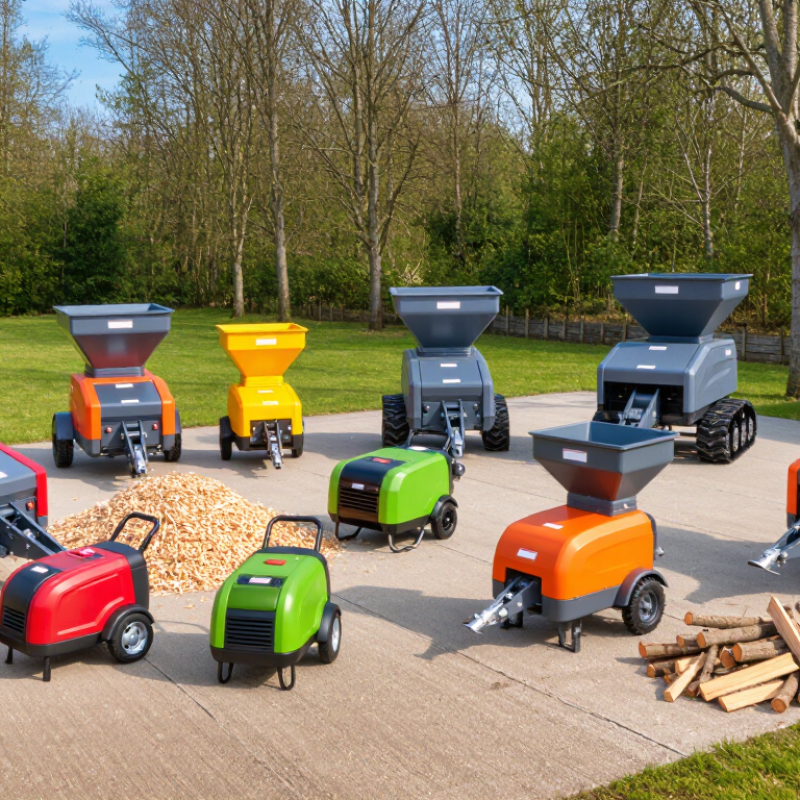
Wood chippers reduce branches and tree waste into chips, but their cutting systems behave differently. Disc chippers use blades mounted on a rotating flywheel. They often produce fairly uniform chips from straight limbs. Drum chippers pull material against knives fixed to a rotating drum. Their broad feed openings can suit bulky brush, though chip size may vary more.
Neither type is automatically best; wet leaves and tangled twigs can slow feeding.
Power source is another useful distinction. Compact electric or engine-driven units suit smaller properties, while tractor-powered and larger engine-driven machines handle heavier workloads. Check the stated maximum branch diameter, feed opening, chip-size adjustment, and discharge direction before buying. A “maximum” limb may be straight and dry, not forked or freshly cut. That matters.
The U.S. Energy Information Administration’s Monthly Energy Review reports that wood and wood-derived fuels supplied roughly 2% of U.S. primary energy use in 2023; this broader energy figure is not a chipper-sales measure, but it shows wood remains a practical feedstock.
Match machine capacity to the material you actually have. A bigger machine can still be the wrong fit.