Icon about-block-ico-1 Icon about-block-ico-2 Icon about-block-ico-3 Icon about-block-ico-4 Icon announcement-close Icon arrow-left Icon arrow-right Icon arrow-sm Icon asterisk Icon banner-transparent-vector Icon btn-callback-ico Icon careers-item-location Icon careers-item-time Icon careers-item-type Icon careers-mail-ico Icon careers-phone-ico Icon careers-search-ico Icon careers-single-hero-vector Icon careers-single-more-vector Icon careers-vector Icon check Icon close Icon dfm-image-left-vector Icon dfm-image-right-vector Icon document Icon download-popup-vector Icon dropdown Icon envelope Icon facebook Icon faq-banner-bg Icon faq-title-ico-active Icon faq-title-ico Icon featured-links-block-bg Icon figure-1 Icon figure-10 Icon figure-11 Icon figure-12 Icon figure-13 Icon figure-14 Icon figure-15 Icon figure-2 Icon figure-3 Icon figure-4 Icon figure-5 Icon figure-6 Icon figure-7 Icon figure-8 Icon figure-9 Icon file-upload Icon form-sidebar-back Icon form-step-done Icon gmap-marker-group-icon Icon gmap-marker-icon Icon header-profile-ico Icon instagram Icon link Icon linkedin Icon loader Icon mail Icon phone Icon play-yt Icon play Icon post-nav-arr-left Icon quote-banner-vector Icon quote-block-aside-vector Icon quote-contact-phone-ico Icon quote-contact-position-ico Icon sidebar-location Icon sidebar-phone Icon technology-banner-nav-left-vector Icon technology-banner-nav-right-vector Icon twitter Icon webinar-item-date-vector Icon whitepaper-img-ico-left Icon whitepaper-img-ico-right Icon whitepapers-listing-banner-ico Icon whitepapers-single-aside-vector Icon youtube Icon yt-play-button

10 Tips for Choosing a Flexible LED Work Light

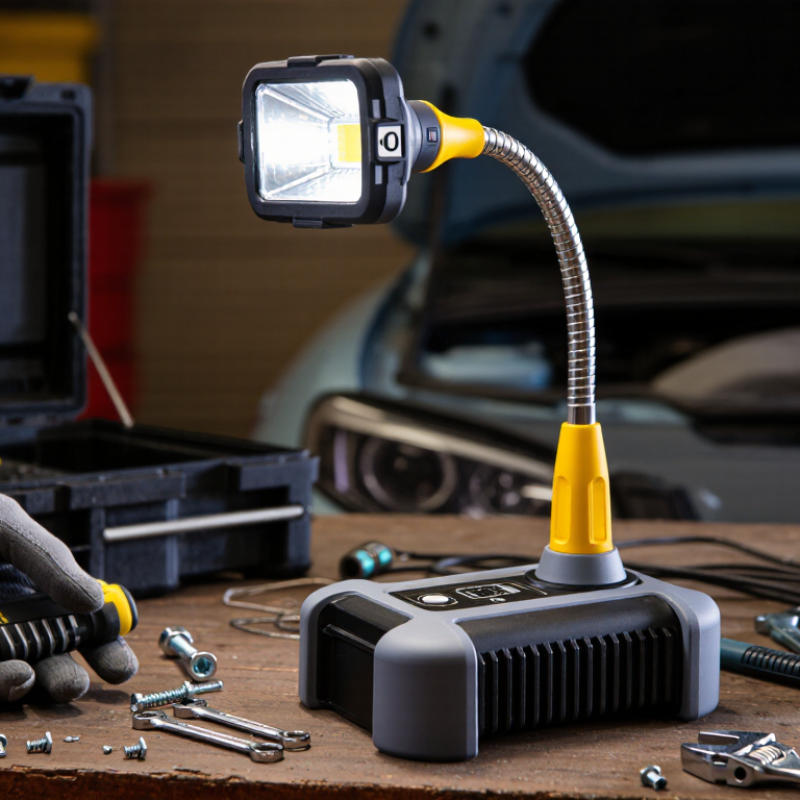
Choosing a Flexible Led Work Light is not just about brightness. The right light must reach awkward spaces, stay steady on uneven floors, and make small details easier to see. Picture a mechanic leaning over an engine bay: a narrow beam, a stiff neck, and a lamp that keeps slipping can slow the job. A flexible neck or adjustable head helps direct light where it is needed, while a stable base, durable housing, and practical controls matter during everyday use.

This guide presents ten considerations, from beam shape and brightness to battery life, charging, grip, and resistance to workshop dust or splashes. There is no single best model for every task. A light suited to close repairs may not illuminate a wider work area well. As a clearly illustrative expert line, workshop-lighting specialist Alex Morgan puts the principle this way: “Choose the light that follows the task, not the one with the biggest number on its box.” Treat that as a buying principle, not a verified quotation. Check product specifications against your working conditions, and look closely at how the lamp bends, stands, and feels in hand. Small details count. Even careful comparisons can miss something: a control may be awkward with gloves, or a flexible neck may not hold its angle. The tips ahead help you assess those trade-offs before choosing.
10 Tips for Choosing a Flexible LED Work Light

Understand the Design and Uses of Flexible LED Work Lights

Flexible LED work lights pair a compact light source with a bendable neck, articulated arm, or strip that can curve around obstacles. That shape helps illuminate the underside of a sink, a crowded engine bay, or a narrow cabinet without moving the whole lamp. The design also has limits. A neck may sag under a heavy lamp head, while a flexible strip can spread light broadly but provide less focused illumination. Check how the light mounts, how far it bends, and whether the housing resists dust or splashes. A bright beam in the wrong direction is still a poor work light.

Light output, color quality, and power source matter as much as flexibility. The U.S. Department of Energy’s Energy Saver guidance says LEDs use at least 75% less energy and can last up to 25 times longer than incandescent lighting. Those figures describe LEDs generally, not every flexible work light. Not magic. Compare the product’s stated lumens and runtime, then consider whether its battery can be replaced or recharged on site. For close inspection, a high color-rendering index can make wire colors and small surface defects easier to distinguish. One common oversight: people test a light in an open room, not in the tight space where glare and shadows become obvious. Check the beam there, if possible.

Define Your Lighting Needs and Work Environment

Before choosing a flexible LED work light, identify what you need to see clearly. A mechanic inspecting a narrow engine bay needs a different beam from someone illuminating a broad workbench. Note the task, working distance, and whether you need focused light or even coverage. A bright beam can still create harsh shadows. Small details matter.

Look closely at the workspace, too. Is it cramped, dusty, or likely to get damp? Check whether the light can fit between shelves or rest securely on an uneven floor. A bendable neck or adjustable head can direct light around obstacles, but it should hold its position during use. That changes everything. Also consider nearby power outlets, battery runtime, and where the cord might snag.

Think about the hours you’ll use it and how your eyes feel afterward. For close, detailed work, a softer, evenly spread beam may be more comfortable than a sharp hotspot. If you move between locations, weight and a stable base become practical concerns. I once assumed maximum brightness was the safest choice; in a reflective space, glare made small parts harder to inspect. The right setup depends on the job, and sometimes you may need to test the light in the actual workspace.

10 Tips for Choosing a Flexible LED Work Light - Define Your Lighting Needs and Work Environment

Tip What to Assess Practical Guidance What to Check
1. Identify the task Decide whether you need broad area lighting or a focused beam for close-up work. Choose a wider beam for work areas and a focused or adjustable beam for inspection and repair tasks. Beam pattern, brightness settings, and whether the light can be aimed precisely.
2. Estimate the required brightness Consider the size of the work surface, distance from the light, and amount of ambient light. For reference, general workshop tasks often use about 300–500 lux, while detailed tasks may need 750–1,000 lux or more at the work surface. Look for a lumen rating and, where available, illuminance information at a stated distance. Measure light at the task area when accuracy matters.
3. Match the environment Check for dust, water spray, humidity, and outdoor exposure. An IP54-rated enclosure offers limited dust ingress protection and protection from water splashes. IP65-rated products are dust-tight and protected against water jets. Confirm the IP rating suits the expected exposure; a rating does not automatically mean a light can be submerged.
4. Choose a useful color quality Determine whether accurate color recognition is important for the job. A CRI of 80 or higher is a common general-purpose choice. A CRI of 90 or higher can be useful for color-sensitive inspection or finishing work. Check the stated CRI and test the light on the materials you work with when color matching is important.
5. Select a comfortable color temperature Consider the appearance of the light and how long you work under it. Neutral white around 4,000–5,000 K is a practical range for many workshop tasks. The best choice depends on personal preference and the surrounding lighting. Check the color temperature rating and avoid mixing very different light colors if consistent visibility matters.
6. Plan for runtime and power Estimate how many hours the light will be used between charging opportunities. Battery runtime generally decreases at higher brightness settings. A corded option may suit a fixed workstation, while a rechargeable model offers more mobility. Review runtime at each output level, charging time, battery replacement options, and any low-battery indicator.
7. Check flexibility and reach Consider whether the light must reach into cabinets, machinery, or narrow spaces. A swivel head, adjustable arm, or flexible neck can help direct light around obstacles and reduce unwanted shadows. Check the adjustment range, stability in position, and whether the design can be placed safely in the intended space.
8. Choose a secure mounting method Decide whether the light needs to stand, hang, attach to metal, or mount to a surface. A stable base works well on benches; hooks, clamps, or magnetic mounts can be useful when suitable attachment points are available. Verify the mounting method, base stability, magnet strength where specified, and safe load limits for clamps or hooks.
9. Reduce glare and shadows Notice reflections from shiny surfaces and shadows cast by your hands or tools. Position the light to illuminate the task from the side or from more than one direction when practical. Diffused output can help soften harsh shadows. Look for adjustable positioning or diffusion, and test the light from the normal working position.
10. Consider durability and handling Assess how often the light will be moved and whether it may experience knocks or vibration. A robust housing and a secure grip can be valuable in mobile work. Follow the product’s operating and storage temperature limits. Check impact-resistance information if provided, cable or charging-port protection, weight, grip, and warranty terms.

Note: Illuminance needs vary with the task, user, and applicable workplace guidance. Treat the lux ranges as general references, not universal requirements.

Compare Brightness, Beam Control, and Power Options

When choosing a flexible LED work light, compare usable light, not just the largest lumen figure. Lumens describe total output; lux shows how much light reaches the work surface. Bright is not always useful. A narrow beam can reveal a screw head, while a wide flood beam helps illuminate a whole bench. Check whether the head pivots smoothly and stays in position. I still find high lumen numbers reassuring, even when they tell me little about glare or shadows.

Beam control matters most when tasks change. Look for separate spot and flood settings, or a dimmer that works without awkward button cycling. The U.S. Department of Energy’s 2020 Energy Savings Forecast for Solid-State Lighting projects 569 TWh in annual U.S. electricity savings by 2035 from LED adoption against its baseline. That is a sector-wide forecast, not a promise about one work light. For product comparisons, check measured output and input power; ANSI/IES LM-79 describes methods for testing solid-state lighting performance.

Power choices affect where the light can go. A battery model suits ladders and unfinished rooms; an AC-powered option avoids charging breaks near an outlet. Compare battery capacity in watt-hours and runtime at the brightness setting you actually use. Check the label. A long runtime on low mode may not help during detailed repair work, and manufacturers’ testing conditions can differ. If possible, try the light at your usual working distance before buying.

10 Tips for Choosing a Flexible LED Work Light

Compare brightness, beam control, and power options to find a work light suited to your task.

Brightness guide: These are practical lumen targets, not a guarantee of illuminance at the work surface. Distance, beam spread, and surface reflectivity all affect how bright the light feels.

  1. Match brightness to the task; avoid paying for output you rarely need.
  2. Choose adjustable brightness to balance visibility and battery life.
  3. Look for a focused beam for detail work and a wide beam for area lighting.
  4. Consider a swivel head or flexible neck to aim light without moving the whole lamp.
  5. Check whether the light can stand, clamp, hook, or attach magnetically where you work.
  6. Compare stated runtime at the brightness level you expect to use.
  7. Choose rechargeable battery power for mobility or corded power for longer sessions near an outlet.
  8. Check charging time and whether the battery can be replaced or charged separately.
  9. For dusty or damp work areas, check the product’s published ingress-protection rating.
  10. Consider size, weight, and handle comfort if you will carry or reposition the light often.

Assess Flexibility, Durability, and Safety Features

A flexible work light should reach awkward spaces without forcing you to balance it on a toolbox. Check how the neck bends and whether it holds its position above a bench or beneath a sink. A wide, stable base helps on flat surfaces, while a strong clip or magnet can be useful on metal frames. Test the controls with work gloves if you expect to wear them. Small detail, big difference.

Durability matters when the lamp gets moved between jobs. Look for a solid housing, protected joints, and a lens that can handle ordinary bumps. Check the stated water and dust resistance, but match it to your actual work conditions; a rating is not a promise of indestructibility. Safety deserves equal attention. Inspect the cable, plug, battery compartment, and charging port for damage, and follow the maker’s instructions for charging and use. Keep the light away from heat sources unless it is rated for them. A flexible neck may still sag after repeated adjustments, and that weakness is easy to miss in a quick shop test. Try it at several angles before relying on it.

Choose a Light That Fits Your Budget and Maintenance Needs

A flexible LED work light should fit the job and the cost of keeping it usable. Compare the purchase price with battery replacement, cleaning, and likely downtime. The U.S. Department of Energy’s LED Lighting fact sheet notes that many LED products are rated for 25,000 to 50,000 hours. That is a useful benchmark, not a promise for a light exposed to drops, dust, or heat. Check the warranty and whether its battery or cable can be replaced. Cheap can become expensive.

Tip: Inspect the hinge, clamp, and cable before buying. A stiff joint that holds its angle is more useful than extra brightness when you are working beneath a sink. Look for a sealed lens and a housing that can be wiped clean. If the light uses a rechargeable battery, check its runtime at the brightness level you actually need. Maximum-output figures can flatter a product.

Tip: Build maintenance into the budget. Keep a spare battery if work cannot pause, and clean the lens with a soft cloth rather than an abrasive pad. Ask whether replacement parts are available separately. A small flaw in my own buying logic: I used to focus on brightness alone. A bright lamp with a loose pivot soon points at the floor.

MSIRobot