Global buyers need more than a low unit price when selecting Steel Shelving. They need capacity, consistency, safety, and dependable delivery across borders. The global warehousing sector continues to expand. Grand View Research valued the warehouse racking market at approximately USD 9.38 billion in 2023 and forecast continued growth through 2030. This trend reflects rising inventory volumes, e-commerce fulfillment, and pressure to use vertical space efficiently.
Reliable purchasing decisions should connect market data with warehouse realities. The 2024 MHI Annual Industry Report highlights ongoing investment in supply-chain technology, labor efficiency, and storage performance. Steel shelving remains practical for cartons, tools, spare parts, and packaged goods. Yet the strongest specification is not always the heaviest one. A shelf holding 200 kilograms may fail operationally if loads are uneven or frequently moved.
Small details matter. Measure clear aisle width, not only room dimensions. Check beam thickness, deck design, corrosion protection, and adjustable pitch. Confirm whether stated capacity applies per shelf or to the entire bay. Ask suppliers for test methods, load charts, material grades, and inspection records. ISO 9001-certified quality systems can support consistency, but certification does not replace product verification.
Think beyond the catalog.
International orders also involve packaging, customs documents, replacement parts, and installation guidance. Regional safety requirements may differ, so buyers should consult qualified local professionals before deployment. No buying guide is flawless. I have seen attractive quotations hide unclear tolerances and incomplete freight assumptions. These ten Steel Shelving buying tips create a disciplined starting point, while careful site inspection and supplier questioning complete the decision.
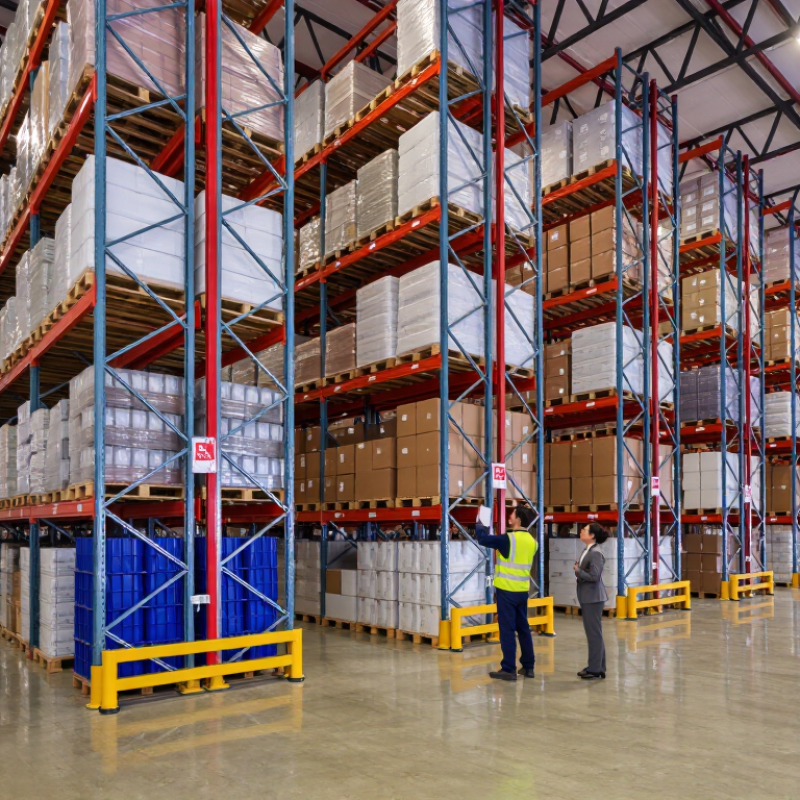
Global buyers should define steel shelving loads with verified ANSI/RMI ratings, not rough visual estimates. ANSI/RMI MH16.1 addresses rated capacities, testing, design, and safe use of industrial steel storage systems. Confirm whether the rating applies to each shelf, bay, or upright frame. Also check whether the load is uniformly distributed or concentrated at specific points.
Apply a 1.5 safety factor during purchasing. For example, a shelf expected to carry 1,500 kilograms should have a rated capacity of at least 2,250 kilograms.
This calculation should include pallets, containers, and handling impact. A neat spreadsheet can still be wrong. Measure real products, uneven weights, shelf spacing, and floor conditions.
Have a qualified structural professional review unusual loads or seismic locations. The U.S. Bureau of Labor Statistics recorded 885 fatal workplace injuries from falls, slips, and trips in 2023. Stable storage deserves serious attention.
Tips:
Request the manufacturer’s load tables and test basis. Confirm shelf deflection limits, connector details, and anchoring requirements.
Never combine ratings from different configurations without written engineering approval. Inspect bent beams, loose clips, and overloaded shelves immediately.
OSHA 1910.176(b) also requires stored materials to remain stable and secure.
In practice, users often forget future inventory growth. Planning only for today may create tomorrow’s overload.
When buying steel shelving internationally, compare the steel grade before comparing the price. Carbon steel offers strong load capacity and usually suits dry warehouses. Galvanized steel adds a zinc layer for humid storage areas. Stainless steel resists corrosion better, but its higher cost may be unnecessary for ordinary indoor use. The environment decides the grade.
Gauge thickness needs careful reading. An 18-gauge panel is thicker and generally stronger than a 20-gauge panel. However, thickness alone does not prove safe performance. Check the shelf span, reinforcement design, beam connections, and stated load rating. A thin shelf with strong supports may outperform a thicker shelf with weak joints. Ask for test methods, not only attractive numbers.
Corrosion resistance depends on more than the coating. Inspect welded corners, cut edges, screw holes, and damaged paint. These small areas often rust first. For coastal warehouses, cold storage, or cleaning zones, request coating details and relevant corrosion test records. Keep shelves away from standing water, even when galvanized. I have seen buyers specify stainless steel, then place it beside leaking pipes. The material was correct, but the installation was not. That mistake is worth reconsidering. Also confirm whether the stated thickness applies to the shelf panel or the entire frame. Suppliers may describe them differently.
Minimum yield strength comparison for commonly specified carbon and stainless steels. Higher values generally indicate greater resistance to permanent deformation, while corrosion resistance depends on the environment, coating, and maintenance.
Reference basis: ASTM A36 and ASTM A572 Grade 50 structural steel minimum yield strengths; ASTM A240 Type 304 and Type 316 stainless steel minimum yield strength for annealed sheet and plate. Gauge thicknesses are typical U.S. sheet-metal conversions and may vary by specification.
Global buyers should verify steel shelving dimensions before comparing prices. Request the exact outside height, width, and depth, not only nominal sizes. Measure twice. A bay listed as 96 inches wide may include posts, braces, or connecting hardware. Those details can reduce usable shelf space.
Check vertical clearances between shelves and above the top beam. Leave room for cartons, hand placement, and safe loading. Measure doorways, lift paths, ceiling height, and aisle width at the installation site. I once focused on shelf dimensions and overlooked a low sprinkler pipe. That assumption was costly to correct. Use a scaled layout when several bays stand together.
A stated 1,000–2,000 lb bay capacity usually means the total load across one complete bay. Confirm whether the rating applies to evenly distributed, static loads. It may not cover concentrated loads, moving equipment, or uneven floors. Ask for written load tables, material thicknesses, beam details, and testing information. Convert the range to roughly 454–907 kilograms for international teams. Keep a practical safety margin below the rated limit. Do not guess. A shelf holding four heavy cartons is not equivalent to one carrying a dense machine part. Confirm the capacity per shelf, per bay, and per configuration. Small differences in bracing can change performance.
Steel shelving can look identical, yet its safety obligations may differ by market. Global buyers should review EN 15635 when purchasing systems used in European workplaces. The standard supports safe installation, loading, inspection, and maintenance. It also expects clear responsibilities after delivery. Ask for load signs, assembly instructions, inspection procedures, and records of corrective actions. A missing document can create more risk than a visible scratch.
ANSI MH16.1 is important for buyers working with applicable North American rack systems. Check whether the proposed design, material strength, connections, and testing match the required application. Do not treat ANSI compliance as interchangeable with EN compliance. They address related risks, but their technical assumptions may differ. Request calculation notes and independent inspection evidence, not only a supplier’s statement. Paperwork matters.
ISO 9001 can show that a manufacturer controls purchasing, production, inspection, and corrective actions. However, it does not prove that every shelving unit is safe for your warehouse. That distinction is easy to miss. Local fire rules, seismic requirements, worker protection laws, and building approvals may also apply. Confirm them with a qualified local engineer or authority before ordering. Measure aisle width, floor condition, anchoring points, and actual carton weights. Buyers sometimes estimate loads too optimistically. Recheck them using real inventory data. Requirements change. Records should change with them.
A 20-foot container usually offers about 33 cubic meters of internal space and roughly 28,000 kilograms of payload. Actual limits vary by carrier, route, and container condition. Steel shelving is dense, so weight can become restrictive before volume does. Measure packed cartons, pallets, uprights, beams, and accessories together. Empty space still costs money.
UNCTAD’s Review of Maritime Transport reports that ships carry over 80% of international trade by volume. Freight exposure is therefore significant. Calculate landed cost per usable shelving unit, not per container alone. Include product price, inland pickup, export handling, ocean freight, insurance, destination fees, duties, and final delivery. A simple formula helps: total delivered cost divided by sellable units. My first estimate is often wrong when pallet height or port charges change.
Incoterms 2020 clarify who pays and who carries risk. Under FOB, the buyer normally controls the main ocean freight and insurance decisions. Under CIF, the seller arranges freight and minimum insurance to the named destination port, but import clearance remains with the buyer. Under DDP, the seller handles nearly every delivery obligation, although local tax rules may complicate the arrangement. Request written quotations with the exact named place, currency, validity period, and container assumptions. Check whether destination charges are included. They often are not. Then test a second scenario with higher freight, exchange-rate movement, and two damaged cartons. That uncomfortable calculation is more realistic.
MSIRobot