Choosing a Package Drop Tester requires more than comparing machine prices or maximum drop heights. The right equipment should reproduce real handling risks, from a carton slipping at waist level to a loaded box striking a hard warehouse floor. This introduction explains the main factors that influence a dependable choice.
A useful tester must match your package size, weight, shape, and testing frequency. Check the platform dimensions carefully. A narrow platform may restrict large cartons, while an oversized model can waste valuable floor space. Review the height range, load capacity, release method, and impact surface. These details affect repeatability and operator safety.
Testing standards also matter. ASTM D5276 and ISO 2248 provide recognized guidance for free-fall drops, but equipment should still fit your internal procedures. A machine that claims compliance is not automatically suitable for every product. Ask for calibration records, service support, and clear operating instructions. Reliable manufacturers should explain how drop height is measured and how accuracy is maintained.
Small details matter.
In practice, I would inspect the controller, safety enclosure, emergency stop, and sample positioning system before making a decision. A loose fixture or inconsistent release can distort results, even when the tester appears advanced. My first assumption was that higher capacity meant better value. That is not always true. A compact, well-calibrated Package Drop Tester may serve a small laboratory more effectively than a powerful industrial model.
The selection process should connect laboratory data with real shipping conditions. Consider product fragility, packaging materials, test repetition, available staff, and future testing needs. This guide will help readers compare those factors with greater confidence, while recognizing that no testing setup is perfect.
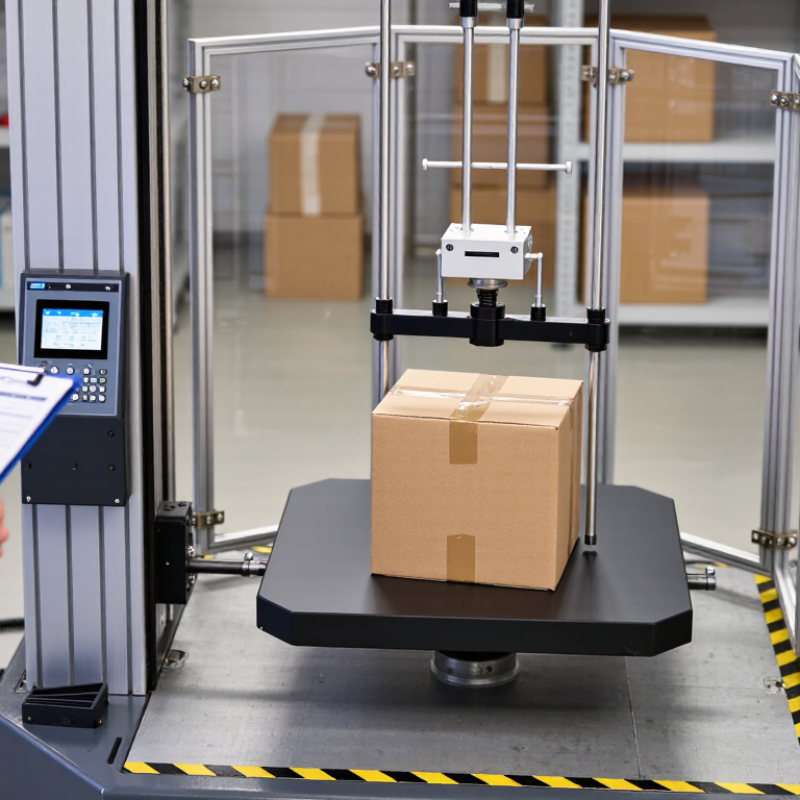
Choosing a Package Drop Tester starts with defining the testing objective. A 2023 global parcel-shipping index reported about 159 billion parcels worldwide in 2022. More shipments mean more unpredictable handling. Your test should reproduce the real journey, not create impressive numbers in a laboratory.
Identify the package’s weight, dimensions, materials, closure method, and product sensitivity. A glass container needs different evidence from a flexible pouch. Record likely drop faces, corners, and edges. Standardized procedures, including ASTM D5276 and ISTA parcel protocols, can guide impact height and sequence selection. These methods improve repeatability, but they cannot represent every warehouse or delivery route. That limitation deserves attention. A tester with adjustable height, a calibrated release system, and a rigid impact surface is usually more useful than a machine with excessive features. Check measurement accuracy and maintenance records. Small errors can change the result.
Tips: Build a test matrix before purchasing equipment. Include empty, nominal, and worst-case package weights. Run repeated drops on several samples, then inspect seals, cushioning, product damage, and usability. Keep photographs and failure notes. A pass is not always enough. The package may survive impact but still waste too much material, time, or labor. Reconsider the test when field complaints do not match laboratory results.
The chart shows commonly used free-fall drop-height baselines for package qualification by gross package mass. Select a drop tester with sufficient load capacity, vertical height, and control accuracy for the highest required test point. The final test plan should also consider package dimensions, center of gravity, cushioning materials, drop sequence, and the distribution environment.
Reference basis: ASTM D5276-style free-fall drop-testing height ranges. Values are shown in metric units for equipment selection.
How to Choose a Package Drop Tester?
Choosing a drop tester starts with the shipment, not the machine. Parcel networks handled 161.8 billion packages globally in 2023, according to the Pitney Bowes Parcel Shipping Index 2024. That volume creates varied impacts. A free-fall tester suits repeatable vertical drops from fixed heights. It works well for cartons, bottles, and boxed products. A rotating-arm tester adds controlled corner and edge impacts. An inclined-impact tester better represents horizontal collisions during conveyor movement.
Configuration matters as much as tester type. Select a platform that fits the largest package you ship, with enough clearance for unstable shapes. Programmable height, accurate release, and automatic recording improve repeatability. For fragile products, add accelerometers or impact indicators. These tools reveal what the carton experienced, not merely whether it opened. ASTM D5276 and ISTA 3A provide recognized procedures for free-fall and parcel testing. Follow the required sequence, orientation, and conditioning period.
Operating method should match real handling conditions. Use a fixed drop height for baseline comparisons, then test different faces, edges, and corners. Rotate packages between trials. Record damage, deformation, product movement, and seal failure. The CSCMP 2024 State of Logistics Report valued United States business logistics costs at about 2.3 trillion dollars in 2023. Avoidable damage deserves careful measurement. Still, laboratory drops are imperfect. Humidity, vibration, and human handling can change results. A practical choice may combine drop, vibration, and compression testing, rather than trusting one dramatic drop.
A reliable drop tester should match your real shipping conditions. Impact height is the first checkpoint. Select a machine that covers the heights required by ASTM D5276 or ISTA procedures. Common evaluations may use flat, edge, and corner drops. A carton falling from 760 millimeters can expose weak seals quickly. Higher settings help simulate warehouse handling and vehicle transfers. However, maximum height alone does not prove quality.
Load capacity matters just as much. The 2023 Global Parcel Shipping Index reported about 161 billion parcels worldwide in 2022. Many packages now contain heavier products, protective inserts, or mixed materials. Choose a tester with enough capacity for the packed product, not only the empty carton. Add a safety margin of at least 20 percent. A machine that struggles under load may produce unstable results. That detail is easy to overlook.
Tips: Check the platform’s levelness before testing. Verify drop height with a calibrated scale or sensor. Record package weight, orientation, conditioning time, and impact sequence. ASTM E4 calibration guidance can support force-measurement reliability, while ISO 17025-based laboratory practices improve traceability. Ask for calibration records and repeatability data. If five identical drops create very different damage patterns, investigate the tester before blaming the package. Real testing is rarely perfect. Humidity, operator alignment, and carton variation can still distort results.
Safety features should guide your purchase. In laboratory practice, a guarded test area prevents fragments from reaching operators. A door interlock should stop the lift immediately when opened. An emergency stop, controlled release mechanism, and overload protection add essential safeguards. Check the actual drop height, load range, and platform size.
Smithers’ The Future of Global Packaging to 2028 projects the packaging market will exceed 1.2 trillion dollars by 2028. More packages require repeatable testing. Small measurement errors can create expensive decisions.
Standards compliance matters as much as machine strength. Ask whether the tester supports ASTM D5276, ISO 2248, or relevant ISTA procedures. Confirm calibration records, height accuracy, impact-surface flatness, and release consistency. A certificate alone does not prove performance.
The World Bank’s What a Waste 2.0 report estimates 2.01 billion tonnes of municipal waste are generated annually. Better drop testing can reduce damaged products and unnecessary replacement packaging. Still, testing cannot represent every courier route. That limitation deserves honest review.
Tips: Inspect welds, guide rails, sensors, and brake components before purchase. Request a sample test with your heaviest package. Compare three repeated drops. If results vary widely, investigate the tester first. Equipment durability also depends on service access, corrosion-resistant surfaces, spare-part availability, and documented maintenance intervals. A powerful frame is not automatically a reliable one.
How to Choose a Package Drop Tester?
A reliable drop tester must record more than pass or fail. Check whether it captures drop height, impact sequence, orientation, acceleration, and test time. Exportable CSV files help engineers compare shipments and identify repeated weak points. Timestamps and operator records also support traceability during customer claims. ASTM D5276 and ISO 2248 provide recognized procedures for free-fall testing, but compliance alone does not guarantee useful data. In practice, a clear report is often more valuable than a larger display.
Maintenance strongly affects total cost of ownership. Ask about calibration intervals, sensor replacement, platform alignment, lubrication, and technician access. A low purchase price can become expensive after repeated downtime. Include software updates, training, spare parts, energy use, and annual calibration in the calculation. The World Bank’s What a Waste 2.0 report estimates 2.01 billion tonnes of municipal solid waste were generated globally each year, with at least 33% unmanaged. Better packaging validation can reduce avoidable damage, though a drop tester cannot solve every distribution problem. The FAO’s 2019 report also estimated that 14% of food is lost between harvest and wholesale. That figure makes data quality important, not decorative. One imperfect assumption remains: laboratory drops cannot fully reproduce every truck, warehouse, or handling event. Therefore, select equipment that preserves raw data and supports repeated testing, rather than trusting one attractive pass result.
| Evaluation Dimension | Basic Manual Unit | Semi-Automatic Unit | Digital Controlled Unit | Integrated Data-Logging Unit | Heavy-Duty Programmable Unit |
|---|---|---|---|---|---|
| Typical application | Occasional checks and basic pass/fail testing | Routine quality-control testing | Repeatable laboratory and production testing | Audited testing and traceable quality records | High-volume testing with multiple drop sequences |
| Typical drop-height range | 300–1,200 mm | 300–1,500 mm | 300–2,000 mm | 300–2,000 mm | 300–2,500 mm |
| Maximum specimen mass | Up to 60 kg | Up to 80 kg | Up to 100 kg | Up to 100 kg | Up to 150 kg |
| Drop-height accuracy | Typically ±10 mm | Typically ±5 mm | Typically ±2 mm | Typically ±2 mm | Typically ±1–2 mm |
| Height setting method | Manual scale and mechanical clamp | Motorized positioning with manual input | Digital controller with stored settings | Digital controller with programmable sequences | Servo-controlled positioning and recipe management |
| Data recording capability | Manual test sheet only | Basic digital height and cycle display | Electronic height, cycle count, and test status | Automatic result files, timestamps, user ID, and test sequence | Automatic records, recipe history, alarms, and network export |
| Data export | Not included | USB or manual transcription, depending on configuration | USB export or local data storage | CSV/PDF export and USB backup | CSV/PDF export, network storage, and system integration options |
| Repeatability for operator-independent testing | Low | Moderate | High | High | Very high |
| Routine maintenance | Lubricate guide rails; inspect clamps and release mechanism monthly | Inspect motor, cable, clamps, and guide rails monthly | Inspect drive system, sensors, controller, and safety switch quarterly | Quarterly inspection plus annual calibration and data-backup review | Monthly inspection, quarterly service, and annual calibration |
| Calibration interval | Every 12 months or after relocation | Every 12 months or after relocation | Every 12 months | Every 12 months with documented traceability | Every 6–12 months, based on usage and internal procedures |
| Estimated purchase cost (USD) | $3,000–$6,000 | $6,000–$12,000 | $12,000–$22,000 | $20,000–$35,000 | $35,000–$60,000 |
| Estimated annual maintenance cost (USD) | $300–$600 | $500–$900 | $800–$1,500 | $1,200–$2,000 | $1,800–$3,000 |
| Estimated five-year TCO (USD) | $4,500–$9,000 | $8,500–$16,500 | $16,000–$29,500 | $26,000–$45,000 | $44,000–$75,000 |
| Potential hidden costs | Operator time, manual records, and inconsistent setup | Replacement cables, clamps, and limited data traceability | Calibration, controller service, and software updates | Data storage, user training, backups, and integration work | Installation, facility requirements, specialized service, and spare parts |
| Best selection when | Testing volume is low and formal electronic records are not required | Testing is regular but the budget is limited | Repeatability and digital control are important | Audit-ready records and traceability justify the investment | Testing volume, specimen size, and automation requirements are high |
MSIRobot