
China Top 10 Color Carbon Fiber Sheets Manufacturers
China’s carbon-fiber sector is expanding as manufacturers serve aerospace, automotive, wind-energy, and consumer-product markets. MarketsandMarkets estimated the global carbon fiber market at USD 6.3 billion in 2023 and forecast USD 11.9 billion by 2028, a projected annual growth rate of 13.6%. These figures cover carbon fiber broadly, not Color Carbon Fiber Sheets specifically. That distinction matters.
For buyers, a colored surface is only part of the specification. Sheet construction, thickness tolerance, weave alignment, resin consistency, and edge quality affect appearance and performance. A glossy red panel can look striking under showroom lights, yet uneven color or pinholes may become obvious near a window. Small details count.
This guide introduces ten Chinese manufacturers for buyers comparing product ranges and supplier capabilities. Consider asking for current technical data sheets, sample panels, production photographs, and clear explanations of color and finish options. Verify whether a quoted sheet is genuine carbon-fiber composite, a surface-finished panel, or another construction; similar wording can describe different products. Do not treat a polished catalog as proof of consistent production. Supplier information can change, and public product descriptions rarely reveal every quality-control detail. A direct sample review remains useful, though it cannot guarantee a full production order will match. The comparisons ahead are a starting point, not a substitute for technical checks.
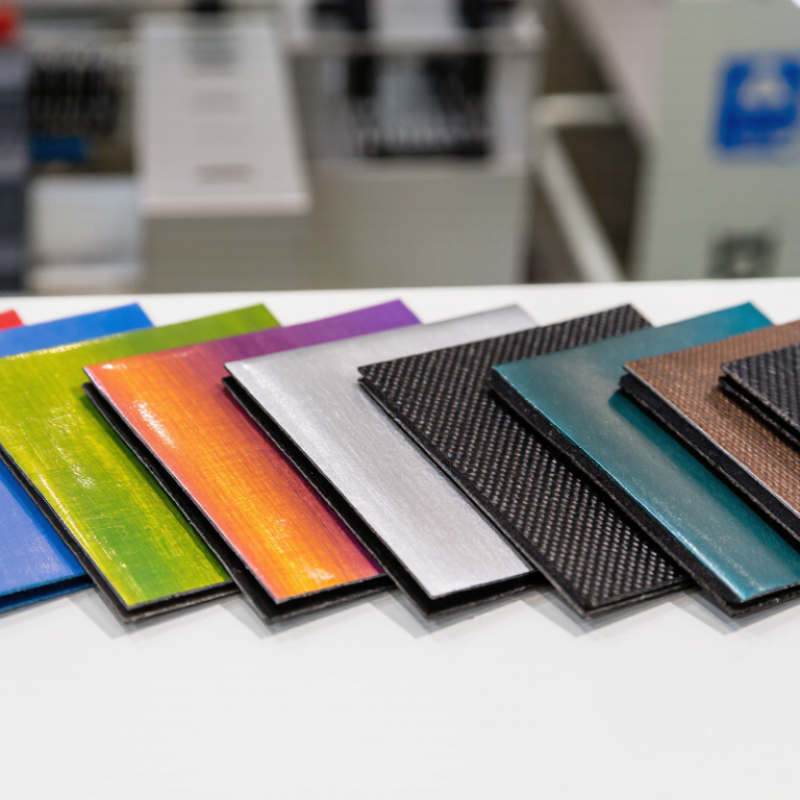
What Defines a Color Carbon Fiber Sheet: CFRP Density of About 1.5–1.6 g/cm³
Color carbon fiber sheets combine reinforced polymer with a colored surface or pigmented resin. Their appearance may range from a subtle tint to a bright, glossy finish. A typical CFRP density is about 1.5–1.6 g/cm³, though the exact value depends on fiber type, resin content, and layup. Density describes mass per unit volume; it does not, by itself, prove strength or workmanship. Color layers and coatings can also affect the finished sheet’s weight slightly.
For buyers comparing manufacturers, this range offers a useful reference, not a strict pass-or-fail rule. Ask for a technical data sheet that identifies the tested product and measurement method. Differences in weave, thickness, resin ratio, or trapped air may shift results. A density figure without its test conditions is less informative. That detail is easy to overlook.
Tips: Compare density alongside thickness, flatness, and surface finish. Check a sample under natural and indoor light, since color can appear different. I would also verify the stated weight on a cut piece; estimates can miss small variations.