Choosing a China Top Color TFT LCD Screen Manufacturer requires more than comparing prices. Buyers should examine engineering experience, production consistency, and long-term support. A reliable supplier understands how screen size, resolution, brightness, viewing angle, and interface selection affect the final device. These details matter in medical equipment, industrial panels, vehicle displays, and smart home products.
An experienced manufacturer should provide clear specifications and practical samples. Ask for information about display materials, driver ICs, touch integration, operating temperature, and quality inspection procedures. A factory with strong technical capabilities can support customized dimensions, mounting holes, cable layouts, and interface requirements. It should also explain testing methods instead of making vague claims. Look closely at the sample. Uneven brightness, slow response, or visible color shifts may reveal deeper production problems.
Certifications and traceable quality records add confidence, but they are not the whole story. Real reliability comes from repeatable processes, responsive communication, and honest technical advice. Some suppliers may offer excellent samples but struggle with volume delivery. That risk deserves attention. Production capacity, component sourcing, packaging protection, and after-sales response should be reviewed before signing an agreement. The best Color Tft Lcd Screen partner is not always the largest factory. It is the manufacturer that understands your application, documents its capabilities, and accepts responsibility when improvements are needed. No supplier is perfect. Careful evaluation remains essential.
China Top Color TFT LCD Screen Manufacturer?
Definition and Role of Color TFT LCD Screens
A color TFT LCD screen uses thin-film transistors to control individual pixels. Each pixel combines red, green, and blue subpixels. This structure produces detailed images, readable text, and smooth color transitions. The screen needs a backlight because liquid crystals do not emit light themselves. Its role extends beyond showing pictures. It presents measurements, warnings, menus, maps, and live operating data.
In practical equipment design, screen performance depends on more than resolution. Brightness affects outdoor readability. Viewing angle matters when operators stand beside the display. Response time can influence moving images. Touch layers, protective glass, and connector placement also affect reliability. A useful evaluation checks the panel under real lighting, temperature, and vibration conditions. A bright display may still disappoint if its contrast weakens in sunlight. This is an easy detail to overlook.
Tips: Match screen size to viewing distance. Check brightness after adding a cover lens. Test colors with real interface graphics, not only sample images. Confirm the operating temperature range and backlight life. Also inspect dead-pixel policies and incoming quality records. Numbers alone cannot describe every viewing experience. I still think some specifications receive too much attention. A balanced assessment should include human use, installation limits, and long-term maintenance.
China Top Color TFT LCD Screen Manufacturer?
Key technologies decide whether a color TFT LCD screen performs reliably in real applications. The TFT backplane controls each pixel through thin-film transistors. Amorphous silicon suits cost-sensitive designs, while LTPS and oxide TFTs can support higher resolution and faster response. Each pixel also uses red, green, and blue color filters. Liquid crystal alignment then regulates the light passing through them.
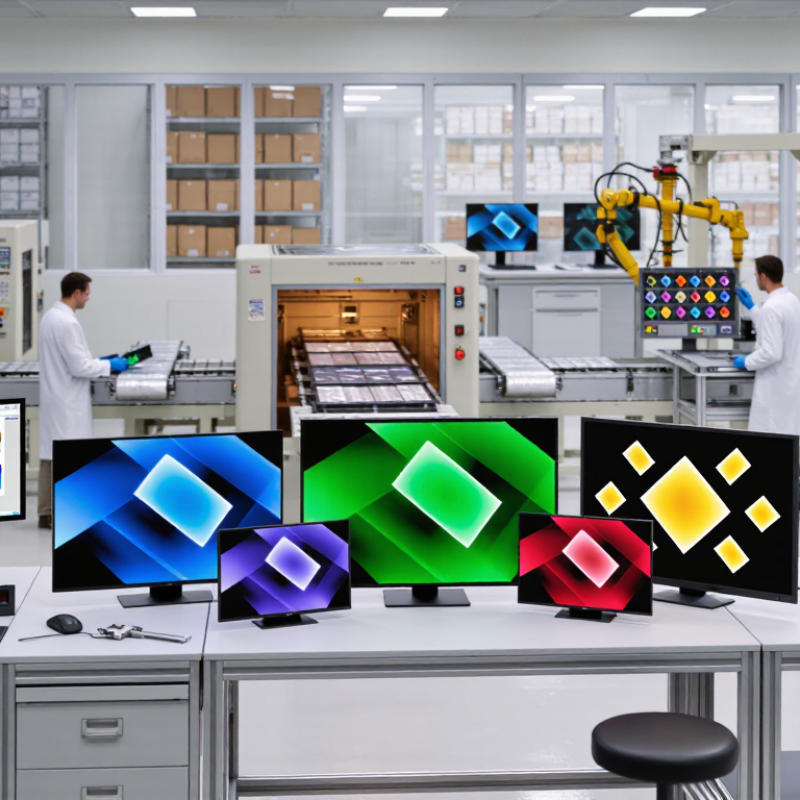
Manufacturing depends on precise photolithography, thin-film deposition, etching, and cleaning. Small dust particles can create dead pixels or uneven brightness. Engineers inspect substrates with automated optical systems before cell assembly. They also control alignment layers, spacer height, sealing pressure, and polarizer placement. Backlight design matters too. Light guides, LEDs, and diffusion films must produce stable brightness across the panel. In practical production reviews, calibration often reveals weaknesses that early visual checks miss. No process is flawless. Temperature drift remains a concern.
Tips: Check viewing angle, contrast, response time, and brightness under actual operating conditions. Ask for uniformity data, environmental test results, and pixel-defect standards. Confirm whether the supplier uses in-line inspection and traceable quality records. A sample may look excellent, yet long-term testing can expose color shifts or backlight aging. That gap deserves attention.
China’s color TFT LCD manufacturing landscape is broad, layered, and highly specialized. There is no single top manufacturer for every application. The market includes panel fabs, glass processors, color-filter lines, driver-IC assembly, and module factories. Large-generation fabs often target televisions and monitors. Smaller lines serve vehicles, medical equipment, instruments, and industrial controls. Each segment requires different pixel density, brightness, lifetime, and touch integration. Scale matters, but it does not solve every problem.
In practice, a reliable supplier should provide traceable process records, not only attractive samples. Engineers inspect mura, dead pixels, viewing angles, response time, and backlight uniformity. Temperature and humidity tests reveal failures that a showroom cannot. Cleanrooms, automated optical inspection, and aging chambers support stable output. Local supply chains can shorten development cycles and simplify engineering changes. However, component availability still shifts, especially for specialized driver chips and advanced materials. That weakness deserves honest discussion.
Experienced buyers often request pilot lots before approving mass production. They compare samples across brightness, color coordinates, viewing angles, and mechanical fit. A screen may look excellent on day one and drift after prolonged heat exposure. Factory data and field feedback then become valuable. Certification support, careful packaging, and responsive technical teams also affect total cost. Quality is not perfectly uniform, even within one production line. Audits remain necessary.
A top Chinese TFT LCD manufacturer should be judged by evidence, not catalog promises. Request samples matching your intended size, interface, brightness, and operating temperature. Inspect viewing angles under real lighting, not only in a dark laboratory. Ask whether the company controls glass sourcing, bonding, backlight assembly, and final inspection. Factory experience appears in small details: clean workstations, stable ESD controls, labeled trays, and operators who explain defects clearly. Details matter.
Evaluate engineering depth through drawings, optical reports, and interface support. A capable team should explain timing, connector pinouts, touch integration, and enclosure limits clearly. Request reliability data for heat, humidity, vibration, and repeated power cycles. Check test conditions, sample sizes, and acceptance limits. A report without test context is weak evidence. Also review traceability. Can each batch be linked to production records and inspection results? This question often separates a manufacturing partner from a simple trading office.
Before placing volume orders, run a pilot batch and measure brightness, color consistency, response behavior, and mechanical fit. Compare results after shipment, not only before it. Confirm lead times, engineering-change notices, warranty handling, and replacement procedures in writing. Speak with the quality manager and production supervisor, not only sales staff. My own evaluation can still be imperfect; one successful sample proves little. Seasonal capacity, component changes, or rushed assembly may alter results. Keep an audit checklist and revisit it during production.
Practical evaluation dimensions and reference benchmarks for comparing color TFT LCD manufacturers without relying on company or brand names.
| Evaluation Category | Key Criterion | Reference Benchmark | What to Verify | Suggested Weight | Assessment |
|---|---|---|---|---|---|
| Display Performance | Panel Technology | TFT LCD with IPS or equivalent wide-viewing-angle technology for applications requiring stable image quality. | Confirm the panel structure, liquid-crystal mode, backlight type, and intended operating environment in the technical datasheet. | 8% | Check |
| Display Performance | Resolution and Pixel Density | The resolution should match the enclosure size, viewing distance, graphics requirements, and host processor capability. | Request the native resolution, active area, pixel pitch, aspect ratio, and a sample showing text and image sharpness. | 7% | Check |
| Display Performance | Brightness | Approximately 300–500 cd/m² is common for indoor equipment; higher levels may be required for outdoor or high-ambient-light use. | Review measured brightness at shipment condition and after any cover glass, touch panel, optical film, or bonding process. | 8% | Check |
| Display Performance | Contrast and Black Level | A static contrast ratio around 800:1 to 1,500:1 is a practical reference range for many IPS-type TFT LCD modules. | Verify the measurement method, test environment, viewing angle, and whether the value is typical or guaranteed. | 6% | Check |
| Display Performance | Color Reproduction | For standard applications, confirm sRGB coverage; for richer color requirements, evaluate a wider-gamut specification such as 72% NTSC or above. | Request color-gamut data, chromaticity measurements, calibration information, and sample images under controlled conditions. | 7% | Check |
| Display Performance | Viewing Angle | A typical wide-viewing-angle target is approximately 80° or more in each direction, with acceptable color and contrast shift. | Review viewing-angle test results and inspect the display from the actual installation position and user perspective. | 5% | Check |
| Reliability | Operating Temperature | Common industrial module specifications include approximately −20°C to +70°C; wider ranges may be required for vehicles or outdoor equipment. | Check the guaranteed temperature range, humidity limits, startup behavior, storage conditions, and temperature-cycle test results. | 8% | Check |
| Reliability | Lifetime and Backlight Stability | An LED backlight lifetime target of 30,000–50,000 hours is commonly used, subject to brightness-retention conditions. | Verify the definition of lifetime, luminance-retention percentage, drive current, temperature, and whether the value is tested or estimated. | 8% | Check |
| Quality Management | Quality System | A documented quality management system aligned with ISO 9001 is a useful baseline for controlled production and traceability. | Request the current certificate, scope, issuing body, expiry date, corrective-action process, and production traceability records. | 8% | Check |
| Quality Management | Inspection and Defect Control | The supplier should define incoming inspection, in-process inspection, final inspection, cosmetic limits, and pixel-defect criteria. | Review the quality agreement, inspection standard, sample approval procedure, nonconforming-product process, and shipment inspection report. | 8% | Check |
| Engineering Capability | Interface Compatibility | The module should support the host system's required interface, such as RGB, MCU, LVDS, or MIPI DSI, with compatible voltage and timing. | Validate pin definitions, timing parameters, initialization commands, logic voltage, connector specifications, and electromagnetic compatibility requirements. | 7% | Check |
| Engineering Capability | Customization Support | A capable supplier should support mechanical drawings, FPC design, cover glass, touch integration, optical bonding, firmware parameters, and backlight changes. | Evaluate engineering response time, drawing accuracy, prototype process, design-change control, tooling ownership, and sample approval workflow. | 7% | Check |
| Compliance | Environmental and Market Compliance | Depending on the destination market, applicable requirements may include RoHS, REACH, CE, FCC, UKCA, or other sector-specific regulations. | Confirm the exact product model covered by each declaration or test report and check material documentation for the finished module. | 6% | Check |
| Supply Capability | Production Capacity and Lead Time | The supplier should provide a realistic sample, pilot, and mass-production schedule with capacity aligned to the forecast volume. | Compare stated lead times with purchase records, production planning, minimum order quantity, safety-stock options, and escalation procedures. | 6% | Check |
| Commercial Evaluation | Total Cost of Ownership | Compare more than the unit price: include tooling, engineering fees, testing, packaging, freight, warranty exposure, yield, and replacement cost. | Request a complete quotation with validity period, payment terms, tooling ownership, warranty terms, after-sales support, and price-adjustment conditions. | 6% | Check |
Note: The benchmarks above are reference ranges or evaluation guidelines, not performance claims for any specific manufacturer. Final selection should be based on verified datasheets, approved samples, audit results, and project-specific requirements.
China Top Color TFT LCD Screen Manufacturer?
Color TFT LCD screens support many everyday and professional applications. Industrial control panels need stable images, physical buttons, and wide viewing angles. Medical equipment requires clear icons, consistent brightness, and easy cleaning. In vehicles, sunlight readability matters more than decorative color. Retail terminals often use projected capacitive touch and protective glass. Each application changes the design priorities.
Future development is moving toward higher brightness, lower power use, and wider color coverage. Oxide TFT technology may improve efficiency and pixel response. Mini-LED backlighting can create stronger contrast, although it increases cost and thermal demands. Thin bezels, optical bonding, and anti-glare coatings are becoming practical choices. Engineers should test displays with gloves, dust, temperature changes, and direct sunlight. Laboratory results alone can mislead. Field testing remains essential.
Tips: Define the viewing distance first. Check brightness after protective glass is added. Ask for sample testing and aging data. Compare touch performance with wet fingers. Do not select a screen by resolution alone. A smaller display with better contrast may work better. Suppliers should provide traceable specifications, inspection records, and realistic delivery information. Even experienced teams sometimes overlook connector placement or cable bending space. That mistake can force costly enclosure changes later.
The chart compares estimated compound annual growth rates for major color TFT-LCD application areas during 2024–2029. Automotive, industrial, and medical displays are expected to grow faster than mature consumer segments because of increasing demand for larger interfaces, higher reliability, touch functionality, and intelligent equipment.
Source: Rounded midpoint estimates synthesized from publicly available 2024–2029 display-industry market forecasts; values are presented without company or brand data.
MSIRobot