Choosing among China’s Insulation Parts manufacturers takes more than comparing prices or factory size. These components may be small, yet a cracked terminal barrier or poorly machined spacer can disrupt an entire assembly. Demand is also tied to expanding power infrastructure. The International Energy Agency’s Electricity Grids and Secure Energy Transitions (2023) estimates that annual grid investment must rise above USD 600 billion by 2030 to meet global needs. That growth puts greater attention on dependable materials and supply chains.
A useful supplier review looks at the material, process, and evidence behind each part. Ask for resin or ceramic specifications, dimensional inspection records, and electrical test results suited to the application. IEC 60243 provides methods for measuring the electrical strength of insulating materials; it is a reference point, not a blanket guarantee of product performance. Request traceable reports, and confirm that test conditions match the intended operating environment. Details matter.
China has a broad manufacturing base, but capability varies between factories. A polished catalogue is not proof. Neither is a large production line. Buyers should check tooling control, batch consistency, communication, and the supplier’s response to nonconforming samples. Some information may be incomplete, and that deserves honest scrutiny. The manufacturers discussed in this guide should therefore be judged by verifiable capabilities, relevant experience, and clear documentation—not by claims alone.
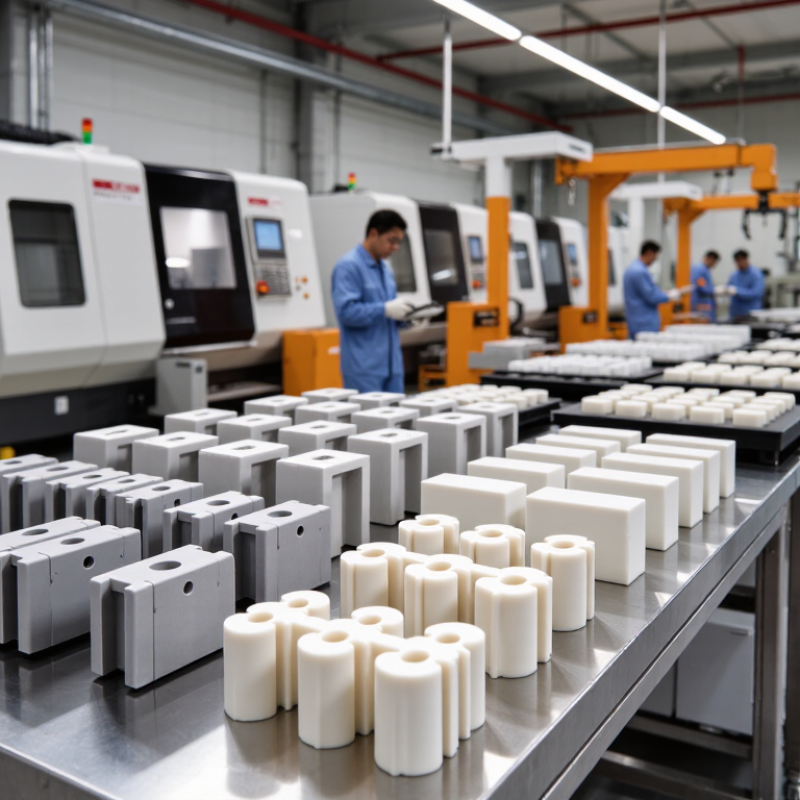
Insulation parts are not interchangeable pieces of plastic. They shape electrical clearances, support live components, and help control heat and vibration. Supports hold busbars, coils, or circuit assemblies at a defined distance from grounded surfaces. Their strength matters. So does the creepage path along the surface, especially where dust or moisture may collect.
Bushings guide conductors through panels or barriers while maintaining electrical separation. Spacers set precise gaps between components; a small height error can shift an assembly or concentrate stress. Laminates combine layers of insulating material for panels, barriers, and structural parts. Their performance depends on the material, layer bonding, thickness, and machining quality. A clean edge matters. Burrs and cracks deserve attention.
When assessing insulation parts manufacturers in China, buyers can review material traceability, dimensional inspection records, and test methods relevant to the intended voltage and temperature. Ask how suppliers control tolerances across repeated production, not just how one sample looks. A neat drawing can hide a rough cut edge. Samples should be checked for fit, finish, and basic dimensions before production approval. It is also wise to confirm whether test data applies to the exact material grade and part geometry. No checklist catches everything; real assemblies sometimes reveal fit issues that drawings missed.
Comparing common insulation materials used in supports, bushings, spacers, and laminates
The chart shows approximate material-level dielectric strength ranges, not manufacturer rankings or guaranteed component ratings. Supports, bushings, spacers, and laminates may use these materials; actual performance depends on grade, thickness, construction, test method, and operating conditions.
When comparing insulation parts manufacturers in China, screen materials against the IEC 60085 thermal classes F (155°C) and H (180°C). These classes describe thermal endurance for electrical insulation systems, not an automatic guarantee that every finished component suits continuous operation at that temperature. Ask suppliers to identify the exact material grade, test basis, and intended application. Details matter.
For woven or nonwoven insulation screens, check thickness, weave consistency, edge quality, and resin compatibility. Request traceable test reports and samples from the same production process used for orders. A careful review should also cover thermal aging, dielectric strength, and dimensional stability under expected heat and moisture. Look closely at the data. A polished datasheet may not show how a screen behaves after repeated heating cycles, so independent testing can help verify performance. Compare how manufacturers control incoming fibers, coating, and batch variation. Some specifications still leave questions. That is a reason to ask for clarification, not to assume the material is unsuitable. Manufacturers with clear documentation and repeatable quality checks are easier to assess for Class F or Class H applications.
When comparing insulation parts manufacturers in China, ask for the CTI value of the exact resin or laminate used—not a general product-family claim. IEC 60112:2020 defines the comparative tracking index test. It evaluates resistance to surface tracking under contaminating liquid, with voltage reported in volts.
The IEC material groups make the thresholds clear. Group I is at least 600 V; Group II is 400 to below 600 V; Group IIIa is 175 to below 400 V. That gap matters. A part rated Group I offers a higher tracking-resistance classification than Group IIIa, which can be relevant around moisture, dust, or electrolyte residue. But CTI alone does not establish a part’s service life or suitability.
Ask suppliers for test reports tied to the material grade, sample thickness, and production batch. Check whether the report identifies the IEC 60112 method and test conditions. For equipment design, IEC 60664-1 also addresses insulation coordination, including creepage distances; CTI should inform, not replace, that assessment. One practical detail is often missed: machining marks or contamination on a finished surface may affect performance. Paperwork helps, but it cannot show every production variation.
For buyers comparing insulation parts manufacturers in China, dielectric strength should be verified with a repeatable test, not inferred from a material datasheet. IEC 60243-1:2013 describes methods for measuring the electrical strength of solid insulating materials under power-frequency voltage. Its short-time method controls the voltage rise until breakdown, with results expressed as electric strength, commonly in kilovolts per millimetre. Ask suppliers for the test method, specimen thickness, electrode details, conditioning, and individual readings. A single headline value can hide uneven results.
A useful supplier review checks whether the report identifies the tested material and production lot, rather than an unrelated laboratory sample. Compare readings across several specimens and inspect the failure points: a puncture near an edge may indicate preparation or electrode issues. IEC 60243-1 provides a consistent testing framework, but it does not prove that every finished component will perform identically in service. Temperature, moisture, geometry, and aging still matter. This distinction is easy to overlook.
Tips: Request the complete IEC 60243-1 test report, including units and test conditions. Confirm that sample thickness matches the intended part. If results vary widely, ask for repeat testing and an explanation before approving the supplier.
Choosing an insulation-parts manufacturer takes more than comparing prices. Rank suppliers by evidence you can verify. Check whether each quality certificate covers the actual production site and product range, not just the company’s general operations. Ask for recent calibration records for measuring tools and inspection equipment. A certificate alone is not proof of consistent output. Request sample inspection reports.
Tolerance control matters when parts must fit tightly around pipes, panels, or equipment. Ask suppliers to state measurable limits for thickness, length, and density, then compare those limits with your drawings. Request samples from normal production, not specially prepared pieces. Small deviations can cause gaps or difficult installation. This is easy to overlook.
Traceability should connect a finished part to its batch, inspection data, and material records. Review a sample batch file before placing a large order. For delivery, compare quoted lead times with actual dispatch records and ask how delays are reported. Track on-time performance across several orders where possible. A polished spreadsheet can still mislead if the data covers only one shipment. I would give the highest ranking to suppliers whose documents, samples, and delivery history agree, while noting any evidence that remains incomplete.
| Priority | Evaluation Dimension | Suggested Weight | Evidence to Request | Practical Scoring Guidance |
|---|---|---|---|---|
| 1 | Dimensional control and tolerances | 25% | Part drawings with agreed tolerances; first-article inspection reports; measurement-system details; capability data for critical dimensions. | Score against the buyer-approved drawing and inspection plan. There is no single universal tolerance for all insulation parts. Where capability indices are used, agree the method, sample size, and acceptance threshold in advance; Cpk ≥ 1.33 is a commonly used reference for stable processes, not a universal requirement. |
| 2 | Certification and compliance evidence | 20% | Current certificates with the supplier’s legal entity, scope, site, and validity dates; product-specific test reports and declarations where applicable. | Verify the certificate directly with its issuer or certification body. ISO 9001 concerns quality-management systems; it is not, by itself, product approval. Consider ISO 14001, IATF 16949, RoHS, or REACH evidence only when relevant to the product and destination market. |
| 3 | Material and lot traceability | 20% | A sample traceability record linking finished-part lot, production date or line, material batch, inspection results, and applicable material certificates. | Run a traceability exercise using a selected finished-part lot. Score the supplier on whether it can retrieve the agreed records accurately and within the response time set in the quality agreement. |
| 4 | Delivery performance and capacity | 15% | Order-level shipment history, confirmed lead times, capacity plan, and records of production interruptions or recovery actions. | Calculate on-time delivery as orders delivered on or before the agreed date ÷ total orders in the review period. Set the target and review period in the sourcing agreement; do not treat a proposed target as verified supplier performance. |
| 5 | Product testing and technical validation | 10% | Test reports for the specified material and part, covering relevant properties such as dielectric strength, insulation resistance, thermal performance, or flammability. | Check that test methods, specimen preparation, material grade, and acceptance limits match the purchase specification. For independent testing, verify the laboratory’s relevant scope; ISO/IEC 17025 addresses testing and calibration laboratory competence. |
| 6 | Corrective action and change control | 10% | Redacted nonconformance and corrective-action records; documented controls for changes to materials, tooling, process, site, or sub-suppliers. | Assess evidence of root-cause analysis, corrective-action verification, and advance customer notification for changes that could affect fit, form, function, or compliance. |
| Total suggested weighting | 100% | Apply the same evidence requirements and scoring rules to every candidate. | ||
Note: This is a supplier-evaluation framework, not a verified ranking of individual manufacturers. No supplier identities or supplier-specific performance data are presented; rank actual candidates only after checking current, comparable evidence.
MSIRobot