Choosing the best 3D Printer Accessory from China is less about finding the lowest price and more about matching a part to your printer, materials, and workflow. China’s manufacturing hubs offer a broad selection, from hardened-steel nozzles and flexible build plates to filament dryers, spare fans, and motion components. The details matter. A nozzle’s thread, a plate’s dimensions, and a dryer’s temperature range can determine whether an upgrade works well—or sits unused in a drawer.
RepRap founder Adrian Bowyer captured the maker spirit behind this market: “The RepRap project is about making self-replicating machines.” That idea favors practical, repairable tools, but it does not make every accessory a smart purchase. Check dimensions, material specifications, seller documentation, and return terms. For a dryer, compare stated temperature control with the filament types you actually use. For a nozzle, verify both fit and wear resistance. Small checks help prevent disappointing prints.
Some accessories are simple wins. Others are not. Reviews can be helpful, yet they may overlook long-term wear, inconsistent batches, or compatibility with less common machines. I would treat unusually broad performance claims with care and test one item before outfitting an entire workshop. This guide will compare useful accessory categories, explain what to check before buying, and highlight trade-offs that product listings often leave out. The best choice is the one that solves a real printing problem, not merely the one with the most features.
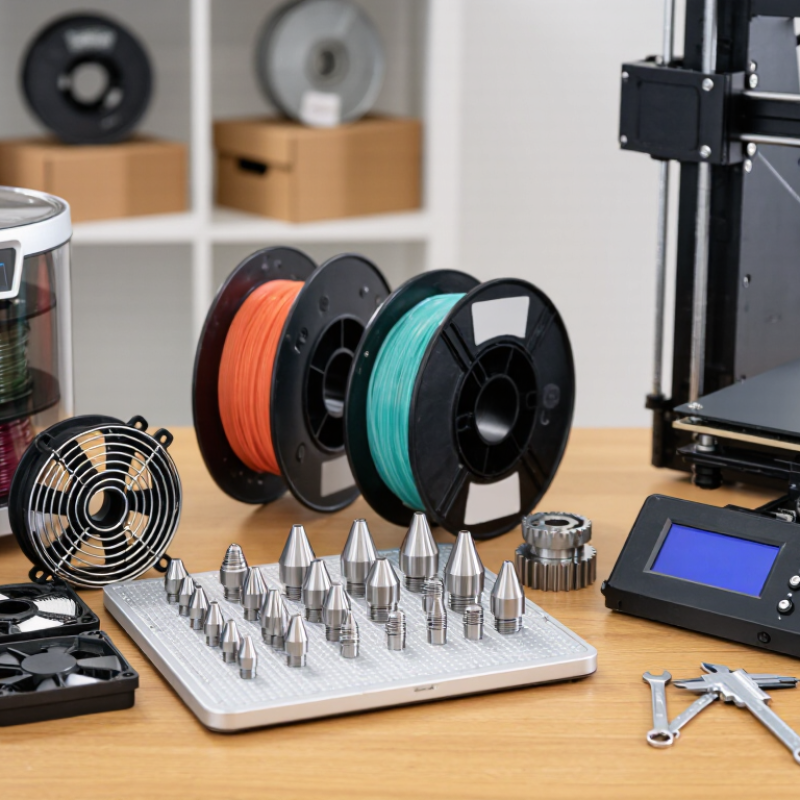
Accessories shape how reliably a printer turns a digital model into a physical part. A textured build plate can improve first-layer grip, while a calibrated probe helps maintain nozzle distance. Small parts matter. A filament dryer reduces moisture that can cause popping sounds, rough surfaces, and brittle strands. An enclosure can steady temperatures around warp-prone materials, though it may also trap heat near electronics. These tools do not replace careful setup. A clean plate and sensible slicer settings still matter.
Chinese suppliers offer accessories such as spare nozzles, silicone socks, PTFE tubing, scrapers, and filament storage bags. Check dimensions, materials, and tolerances before ordering; similar-looking parts are not always interchangeable. For example, a nozzle’s thread and length must match the hot end. Not always. Start with the printer’s manual and change one variable at a time. This makes print problems easier to diagnose. It is tempting to buy a tool for every issue, but accessories can add clutter without improving results. Choose one that addresses an observed problem, then test it on a small, simple model.
Nozzle diameter affects the balance between detail and printing speed. A 0.4 mm nozzle is a widely used general-purpose option; smaller diameters suit finer details, while larger ones can deposit wider lines and print faster, depending on the printer and settings.
Chinese manufacturers produce a wide range of 3D printer accessories, from replacement parts to workshop tools. Hotends, nozzles, and extruder components help manage filament flow and print detail. Brass nozzles suit many everyday materials, while hardened options handle abrasive filaments better. Check nozzle diameter and thread compatibility before ordering. Small mismatches matter.
Build plates and surface coatings are another common category. Flexible spring-steel sheets can make parts easier to remove, while textured surfaces may improve first-layer grip. Results depend on the filament, bed temperature, and cleaning routine. A glossy plate can look impressive, but it may not suit every material. Test carefully.
Motion and maintenance accessories include belts, bearings, fans, cable chains, and leveling tools. Enclosures and air filters are also available for managing drafts and workshop particles; their performance varies with design and upkeep. Look for clear measurements, material details, and installation instructions. Reviews with close-up photos can help, but they are not proof of quality. Some listings leave out useful tolerances. That deserves a second look. A simple caliper check and a small test print can reveal fit problems before a full project begins.
When comparing 3D printer accessories, start with the material, not the product photos. A hardened steel nozzle can resist abrasive filament better than a standard brass nozzle, but it may transfer heat differently. For build plates, check the surface coating, thickness, and stated temperature range. A smooth sheet can help with detailed parts; a textured one may leave a visible pattern. Small details matter.
Compatibility is more than matching a printer model. Check nozzle diameter, thread size, bed dimensions, connector type, and firmware requirements. Measure before ordering. Fit matters. A cable that reaches the control board may still use the wrong connector. I would double-check that point, even when a listing looks clear. Listings can be incomplete, and compatibility claims are not always tested across every machine.
The Wohlers Report 2024 estimated that the additive manufacturing industry reached about $20.0 billion in 2023, growing 11.1% from the previous year. That figure covers the wider industry, not accessory quality, so it cannot confirm that a particular part will last. Ask for measurable specifications, such as material grade, dimensional tolerance, and operating temperature. Better evidence beats polished packaging. I still find accessory comparisons awkward when sellers omit tolerances. That gap deserves attention.
| Accessory | Common Materials | Build-Quality Checks | Compatibility to Verify | Best Suited For |
|---|---|---|---|---|
| Flexible build plate | Spring steel sheet with a PEI-coated or textured PEI surface | Check that the sheet lies flat, the coating is even, and the edges are free of burrs. A magnetic base should hold the sheet securely. | Match the bed’s length and width; confirm whether the printer has a compatible magnetic base. Check the surface’s temperature limits before use. | Convenient print removal and a reusable build surface for many common filament types. |
| Brass nozzle | Brass, commonly supplied with a 0.4 mm orifice | Look for a clean, round orifice, smooth threads, and a consistent opening. Avoid visible burrs or damaged threads. | Confirm thread type, nozzle length, and seating style for the specific hotend. Match the orifice size to the desired detail and flow rate. | General-purpose printing with standard, non-abrasive filaments such as PLA, PETG, and ABS. |
| Hardened-steel nozzle | Hardened steel; some versions use a wear-resistant surface treatment | Check for a smooth internal path, clean machining, and undamaged threads. Confirm the material and any stated wear-resistance details. | Verify the same hotend dimensions and thread requirements as for any replacement nozzle. Review the printer’s temperature capability, as steel can transfer heat differently from brass. | Filaments containing abrasive particles, such as carbon-fiber, glass-fiber, or glow-in-the-dark formulations. |
| PTFE Bowden tube | PTFE tubing; 4 mm outer diameter and 2 mm inner diameter are common, but not universal | Check that the tube has a consistent inner diameter, a clean cut, and a smooth, undamaged surface. A square end helps it seat properly. | Measure the required inner and outer diameters and length. Confirm the printer’s fitting type and hotend design; temperature suitability depends on the system and tube specification. | Replacing worn filament-feed tubing in compatible Bowden-style setups. |
| Replacement extruder gear | Hardened steel or stainless steel, depending on the design | Check tooth definition, gear alignment, shaft fit, and surface finish. The gear should rotate smoothly without noticeable wobble. | Match the gear’s bore, tooth profile, diameter, and mounting method to the extruder. Single- and dual-gear systems may require different parts. | Restoring reliable filament grip when an existing drive gear is worn or damaged. |
| Hotend silicone sock | Heat-resistant silicone elastomer | Check for a consistent shape, clean openings, and a snug fit without tearing or stretching. | Match the sock to the hotend block’s shape and dimensions. Ensure it does not obstruct the nozzle, heater, or temperature sensor. | Reducing heat loss and helping keep stray filament from sticking to the heater block. |
Selection tip: Confirm dimensions, mounting style, and temperature limits against the printer and accessory specifications before ordering. Similar-looking parts are not necessarily interchangeable.
A textured spring-steel build plate can improve first-layer grip and make finished prints easier to remove. Check its dimensions and temperature limits before buying; a plate that does not match the printer may cause uneven heating. A filament dryer is useful in damp rooms, where moisture can leave rough surfaces or tiny popping sounds during extrusion. Small details matter. A simple enclosure can reduce drafts, but it should not trap excessive heat around electronics.
For routine maintenance, keep a digital caliper, soft brush, and suitable nozzle-cleaning tools nearby. A caliper helps check whether printed parts match their intended dimensions. Remove dust from rails and fans gently, and use only the lubricant recommended for the printer’s moving parts. Too much oil can attract debris. Not every upgrade helps. I have found that careful calibration often improves print quality more than adding another accessory.
Safety equipment deserves equal attention. Place the printer on a stable, heat-resistant surface, and keep loose cables away from moving parts. A working smoke alarm nearby offers an extra layer of protection, while ventilation helps clear odors from some printing materials. Do not leave a new setup unattended until you understand its normal sounds and temperatures. A small enclosure fan may help, but airflow needs vary with the material and room.
Choosing a Chinese supplier for 3D printer accessories takes more than comparing prices. Check whether the supplier understands the part’s actual use, such as a hotend’s temperature range or a belt’s width and tooth profile. Ask for clear specifications, material details, and photos of the production sample. Good answers should be specific, not copied from a generic catalog.
A polished listing is a weak signal, not proof of consistent quality. Request a small sample order and inspect fit, finish, and packaging before discussing larger quantities. For example, check whether a fan’s connector matches your wiring and whether mounting holes align with your printer. Ask how the supplier handles defects, replacement parts, and production changes. Put agreed tolerances and inspection steps in writing. Keep communication in one documented channel. No checklist catches every issue. I would also compare response times over several days, because a quick first reply can create false confidence. Shipping estimates, export paperwork, and packaging details deserve the same careful review as the accessory itself.
MSIRobot