Icon about-block-ico-1 Icon about-block-ico-2 Icon about-block-ico-3 Icon about-block-ico-4 Icon announcement-close Icon arrow-left Icon arrow-right Icon arrow-sm Icon asterisk Icon banner-transparent-vector Icon btn-callback-ico Icon careers-item-location Icon careers-item-time Icon careers-item-type Icon careers-mail-ico Icon careers-phone-ico Icon careers-search-ico Icon careers-single-hero-vector Icon careers-single-more-vector Icon careers-vector Icon check Icon close Icon dfm-image-left-vector Icon dfm-image-right-vector Icon document Icon download-popup-vector Icon dropdown Icon envelope Icon facebook Icon faq-banner-bg Icon faq-title-ico-active Icon faq-title-ico Icon featured-links-block-bg Icon figure-1 Icon figure-10 Icon figure-11 Icon figure-12 Icon figure-13 Icon figure-14 Icon figure-15 Icon figure-2 Icon figure-3 Icon figure-4 Icon figure-5 Icon figure-6 Icon figure-7 Icon figure-8 Icon figure-9 Icon file-upload Icon form-sidebar-back Icon form-step-done Icon gmap-marker-group-icon Icon gmap-marker-icon Icon header-profile-ico Icon instagram Icon link Icon linkedin Icon loader Icon mail Icon phone Icon play-yt Icon play Icon post-nav-arr-left Icon quote-banner-vector Icon quote-block-aside-vector Icon quote-contact-phone-ico Icon quote-contact-position-ico Icon sidebar-location Icon sidebar-phone Icon technology-banner-nav-left-vector Icon technology-banner-nav-right-vector Icon twitter Icon webinar-item-date-vector Icon whitepaper-img-ico-left Icon whitepaper-img-ico-right Icon whitepapers-listing-banner-ico Icon whitepapers-single-aside-vector Icon youtube Icon yt-play-button

10 Best 3D CNC Automatic Tube Bending Machines for 2026

Choosing a tube bender is less about impressive specifications and more about producing accurate parts, shift after shift. A 3D CNC Automatic Tube Bending Machine can form complex tube paths while controlling bend angles, rotation, and feed length. Yet performance depends on the material, tube diameter, wall thickness, and tooling—not just the machine’s advertised capacity.

This guide compares ten machines for 2026, focusing on practical factors buyers can verify: supported tube sizes, bending accuracy, CNC controls, setup requirements, automation options, and service support. Look closely at tooling compatibility and changeover time. Small details matter. A machine that handles a demanding radius but takes too long to set up may not suit a high-mix production line. Likewise, headline speed means little if finished parts need frequent correction.

The right choice depends on the work. A compact shop making short runs may value flexible programming and straightforward setup, while a larger facility may prioritize automated loading and consistent cycle times. Specifications can also vary by configuration, so confirm details with the manufacturer before comparing prices. No ranking can replace a production trial. Treat this list as a starting point, then match each machine to your actual tube drawings, materials, and daily output. We also note where published information leaves questions worth asking. That part is easy to overlook.
10 Best 3D CNC Automatic Tube Bending Machines for 2026

What Is a 3D CNC Automatic Tube Bending Machine?

A 3D CNC automatic tube bending machine turns straight metal tubing into programmed shapes across several planes. Its controller coordinates three core motions: tube feed, tube rotation, and bend-arm rotation. Clamps hold the tube while tooling applies pressure; a mandrel may support its interior during tight-radius bends. The operator enters the part geometry, material, diameter, wall thickness, and bend sequence. The machine then repeats the cycle with limited manual handling. In practice, “3D” describes bends oriented in space, not necessarily a machine with only three axes. That distinction matters.

Setup still needs judgment. Springback, weld-seam position, and wall-thickness variation can shift a bend away from its target. Measure a first-off part at several points, including bend angle, centerline radius, and ovality. Then verify compensation settings on later batches. Even a clean simulation can miss real material variation. Grand View Research’s 2024 CNC machine market report valued the global market at $101.22 billion in 2023 and projected 6.3% annual growth through 2030. This is broad CNC-market context, not a tube-bender sales figure. When comparing machines, check repeatability, supported tube sizes, minimum bend radius, changeover time, and guarding—not speed alone. A fast cycle is not always a good part.

10 Best 3D CNC Automatic Tube Bending Machines for 2026 — What Is a 3D CNC Automatic Tube Bending Machine?

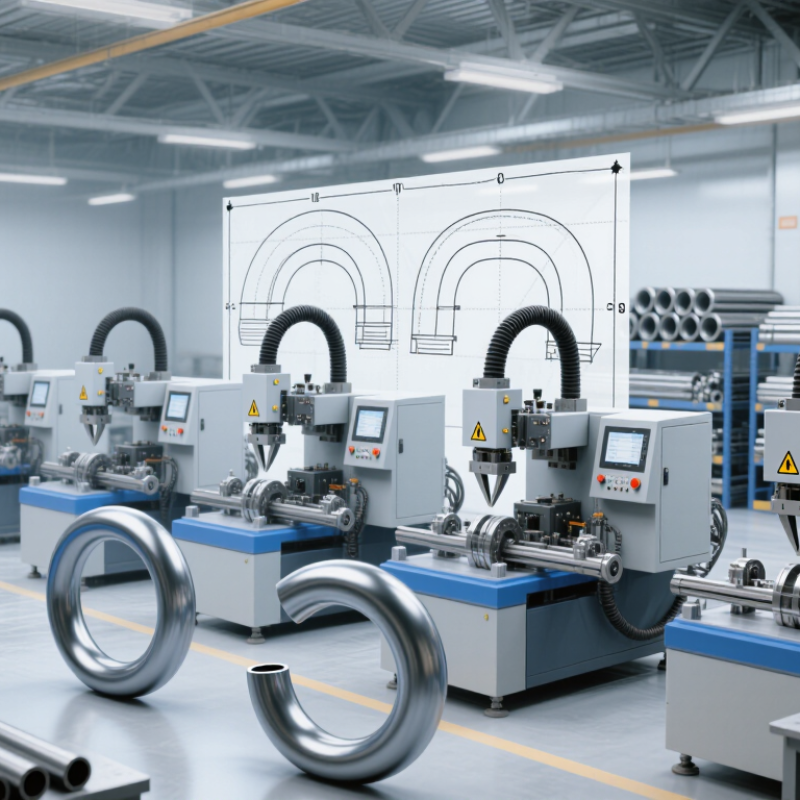
A 3D CNC automatic tube bending machine feeds and rotates a tube, then bends it to programmed angles in multiple planes to create a three-dimensional shape. The chart shows example bend angles as geometric references—not specifications or rankings for any particular machine. Actual bending limits depend on the machine, tooling, tube material, and tube dimensions.

How 3D CNC Tube Bending Technology Works

A 3D CNC tube-bending machine turns a digital tube path into controlled movements. The operator enters bend angles, radii, and distances between bends. The controller coordinates the feed axis, which advances the tube, with rotation and bending axes. Together, these movements create bends in different planes. Small changes matter. A few millimeters of feed error can shift a later bend and spoil alignment with a fixture.

The International Federation of Robotics reported 4.28 million industrial robots operating worldwide in 2023, up 10% from 2022, in its World Robotics 2024 report. That figure reflects wider factory automation, not tube benders specifically. In a bending cell, CNC control helps repeat a saved sequence, while tooling supports the tube and limits flattening or wrinkling. A mandrel may be used for tight bends or thin-walled tube. Setup still matters.

Metal springs back after bending. The controller or operator must account for this using material data, test bends, or measured results. Wall thickness, alloy, lubrication, and tool wear can all change the final shape. This is easy to underestimate. Even a well-programmed machine may need correction after the first part. Inspecting bend angles and checking the finished tube against its drawing helps verify the process.

Key Factors for Comparing Tube Bending Machines in 2026

When comparing 3D CNC automatic tube bending machines in 2026, start with the parts you actually make. Record tube diameter, wall thickness, material, bend radius, and finished-part tolerance. A machine’s maximum capacity means little if your daily stainless-steel tube springs back or wrinkles at a tight radius. Ask suppliers to run your drawings and material samples, then inspect the finished parts. Real parts reveal more than a polished specification sheet.

Look beyond bending speed. Check repeatability across a full shift, changeover time, tooling availability, scrap tracking, and how easily operators can adjust programs. Deloitte and MAPI’s 2019 Smart Factory Study found that 86% of surveyed manufacturers expected smart-factory initiatives to drive competitiveness within five years. For a tube bender, that makes data access and integration worth checking, not just headline automation claims. Still, a connected machine is not automatically a useful one.

Operator support matters, too. A 2024 study by Deloitte and The Manufacturing Institute projected that 3.8 million manufacturing jobs could be needed by 2033, with 1.9 million potentially unfilled. Compare training hours, diagnostic clarity, and routine maintenance access alongside price. Ask who can restore production after a sensor fault. Small details count. I would also challenge one assumption: the fastest cycle may not be the lowest-cost choice when setup, rework, and operator time are included.

10 Best 3D CNC Automatic Tube Bending Machines for 2026

For 2026, the ten best 3D CNC automatic tube bending machines are not one-size-fits-all. A practical shortlist should cover distinct shop needs: compact servo bending, high-volume production, multi-stack tooling, mandrel-supported bends, large-diameter tube, thin-wall material, tight radii, mixed profiles, robotic cells, and precision feedback systems. Each type solves a different problem. Match capacity to your actual tube diameter, wall thickness, material, and bend radius—not a dramatic catalog maximum.

On the shop floor, repeatability matters. Watch how quickly an operator can load a program, set the clamp, and verify the first part. A clean bend should show little flattening or wrinkling. Check whether the machine stores tooling offsets and reports errors clearly. Ask for a trial using your own tube; polished demonstrations can hide setup issues. Also inspect guarding, service access, and spare-part availability. A faster cycle is useful, but not if changeovers eat the shift. I’d be cautious about ranking machines by speed alone. It’s an easy number to compare, and an imperfect guide. For mixed production, software flexibility and dependable calibration may matter more than peak output.

Industries and Applications for 3D CNC Tube Bending Machines

Automotive production is a major application for 3D CNC tube bending. OICA reported approximately 93.5 million motor vehicles produced worldwide in 2023. Tubes serve in exhaust assemblies, seat frames, chassis reinforcements, and fluid lines. Repeatable bends help parts fit fixtures and adjacent components. Small angle errors can create costly assembly delays. It sounds simple; it isn’t.

Electric vehicles are expanding demand for formed tubes in cooling circuits, battery thermal management, and lightweight structures. The International Energy Agency’s Global EV Outlook 2024 estimates that nearly 14 million electric cars were sold in 2023, about 18% of global car sales. HVAC and building services are another practical market: bent tubes route refrigerant and water around tight corners in heat pumps and air-conditioning units. A neat drawing does not always reflect the awkward access conditions on a real shop floor.

Aerospace uses precision-bent tubes in cabin systems and fluid routing, where fit and inspection matter. Agricultural and construction equipment also rely on formed hydraulic lines that must clear moving parts and withstand vibration. Medical carts, laboratory equipment, and furniture use smaller tube assemblies for frames and supports. The right bend sequence depends on material, wall thickness, and clearance. In production, reliable setups can matter more than headline speed. Even experienced operators sometimes need another trial bend.

10 Best 3D CNC Automatic Tube Bending Machines for 2026 - Industries and Applications for 3D CNC Tube Bending Machines

The entries below are application-oriented machine categories, not specific products or ranked brand recommendations. Capacity ranges are representative planning guides; actual limits depend on tube material, wall thickness, bend radius, tooling, and machine configuration.

No. Machine Configuration Typical Tube OD Typical Wall Thickness Typical Bending Setup Common Materials Industries Typical Applications
1 Compact precision CNC bender 6–16 mm (0.24–0.63 in) 0.5–1.5 mm (0.020–0.059 in) Single-stack tooling; automatic feed, rotation, and bend control; suited to small-radius work when matched tooling is used Stainless steel, copper, aluminum, and low-carbon steel Medical equipment, instrumentation, electronics, and small appliances Instrument lines, compact fluid tubes, sensor tubing, and small formed tube assemblies
2 Small-diameter multi-plane CNC bender 8–25 mm (0.31–0.98 in) 0.6–2.0 mm (0.024–0.079 in) Automatic tube feeding and rotation for bends in multiple planes; optional multi-stack tooling Stainless steel, aluminum, copper, and carbon steel Automotive, appliance, HVAC, and furniture manufacturing Fuel and fluid lines, appliance tubing, small exhaust sections, and tubular frames
3 General-purpose mid-size CNC bender 10–38 mm (0.39–1.50 in) 0.8–3.0 mm (0.031–0.118 in) Automatic feed, rotation, and bend axes; commonly configured for single- or multi-stack production Carbon steel, stainless steel, aluminum, and copper alloys Automotive, HVAC, agricultural equipment, and general fabrication Fluid lines, handrails, chassis tubes, heat-exchanger connections, and formed brackets
4 High-volume automotive tube bender 6–50 mm (0.24–1.97 in) 0.7–3.5 mm (0.028–0.138 in) Production-oriented CNC control with automatic loading options, part programs, and multi-plane bending Carbon steel, stainless steel, aluminum, and coated steel tubing Automotive and commercial vehicle manufacturing Brake, fuel, cooling, air-conditioning, seat-frame, and exhaust-system tubes
5 Thin-wall mandrel-bending CNC system 10–60 mm (0.39–2.36 in) 0.6–2.5 mm (0.024–0.098 in) Mandrel and wiper-die capability for supporting thin-wall bends; practical radius depends on material and tooling Stainless steel, aluminum, and low-carbon steel Automotive, aerospace supply chains, furniture, and recreational vehicles Thin-wall exhaust pipes, visible trim tubes, lightweight frames, and smooth-flowing tube assemblies
6 Multi-stack, multi-radius CNC bender 12–76 mm (0.47–2.99 in) 1.0–4.0 mm (0.039–0.157 in) Multiple tool stacks allow different bend radii or tube sizes to be used within a programmed part family Carbon steel, stainless steel, and aluminum Automotive, bus and rail, HVAC, and industrial machinery Complex exhaust assemblies, vehicle structures, handrails, and multi-radius pipework
7 Large-diameter structural tube bender 38–100 mm (1.50–3.94 in) 2.0–6.0 mm (0.079–0.236 in) Heavy-duty rotary-draw setup with reinforced clamping and tooling; larger sections generally require larger bend radii Carbon steel, stainless steel, and structural aluminum alloys Construction equipment, transport, energy, and industrial fabrication Structural frames, large handrails, equipment guards, and heavy-duty fluid or exhaust tubing
8 High-strength steel tube CNC bender 20–80 mm (0.79–3.15 in) 1.5–5.0 mm (0.059–0.197 in) High-clamping-force configuration with material-specific tooling and springback compensation High-strength low-alloy steel, carbon steel, and selected stainless steels Automotive safety structures, agriculture, construction, and heavy vehicles Reinforcement members, roll structures, protective frames, and load-bearing tube assemblies
9 Large-section CNC bender for industrial pipework 60–150 mm (2.36–5.91 in) 3.0–10.0 mm (0.118–0.394 in) Heavy-duty machine frame and large tooling; setup and bend radius are selected for the material and section Carbon steel, stainless steel, and selected alloy steels Energy, shipbuilding, process equipment, and large-scale manufacturing Industrial pipe runs, large exhaust sections, structural members, and equipment connections
10 Flexible CNC cell with automatic handling 6–100 mm (0.24–3.94 in), depending on machine module Material- and diameter-dependent CNC bending combined with optional automatic loading, unloading, measuring, or part transfer equipment Carbon steel, stainless steel, aluminum, and copper alloys Contract manufacturing, automotive suppliers, HVAC, and general industry Mixed-part production, repeatable batch runs, and tube assemblies requiring consistent multi-plane geometry

MSIRobot