Icon about-block-ico-1 Icon about-block-ico-2 Icon about-block-ico-3 Icon about-block-ico-4 Icon announcement-close Icon arrow-left Icon arrow-right Icon arrow-sm Icon asterisk Icon banner-transparent-vector Icon btn-callback-ico Icon careers-item-location Icon careers-item-time Icon careers-item-type Icon careers-mail-ico Icon careers-phone-ico Icon careers-search-ico Icon careers-single-hero-vector Icon careers-single-more-vector Icon careers-vector Icon check Icon close Icon dfm-image-left-vector Icon dfm-image-right-vector Icon document Icon download-popup-vector Icon dropdown Icon envelope Icon facebook Icon faq-banner-bg Icon faq-title-ico-active Icon faq-title-ico Icon featured-links-block-bg Icon figure-1 Icon figure-10 Icon figure-11 Icon figure-12 Icon figure-13 Icon figure-14 Icon figure-15 Icon figure-2 Icon figure-3 Icon figure-4 Icon figure-5 Icon figure-6 Icon figure-7 Icon figure-8 Icon figure-9 Icon file-upload Icon form-sidebar-back Icon form-step-done Icon gmap-marker-group-icon Icon gmap-marker-icon Icon header-profile-ico Icon instagram Icon link Icon linkedin Icon loader Icon mail Icon phone Icon play-yt Icon play Icon post-nav-arr-left Icon quote-banner-vector Icon quote-block-aside-vector Icon quote-contact-phone-ico Icon quote-contact-position-ico Icon sidebar-location Icon sidebar-phone Icon technology-banner-nav-left-vector Icon technology-banner-nav-right-vector Icon twitter Icon webinar-item-date-vector Icon whitepaper-img-ico-left Icon whitepaper-img-ico-right Icon whitepapers-listing-banner-ico Icon whitepapers-single-aside-vector Icon youtube Icon yt-play-button

2026 Top Industrial Motherboard Types for Global Buyers?

Choosing an Industrial Motherboard in 2026 requires more than comparing processor speed and purchase price. Global buyers must match board design with operating conditions, software demands, maintenance plans, and regional compliance needs. A dusty packaging line, a refrigerated warehouse, and a compact medical device may require completely different platforms.

This guide examines the main industrial motherboard types available to international buyers. It covers ATX, MicroATX, Mini-ITX, 3.5-inch single-board computers, COM-based systems, and backplane-oriented solutions. Each type offers a different balance of expansion, size, power use, serviceability, and long-term availability. Some boards support multiple PCIe slots for machine vision or motion control. Others fit inside a sealed 200-millimeter enclosure.

Real deployment experience shows that specifications can hide practical risks. A powerful chipset may create unnecessary heat. A low-cost board may offer limited BIOS support. That assumption can fail.

The discussion also considers processor generations, ECC memory, storage interfaces, watchdog functions, remote management, fanless cooling, and operating temperature ranges. Buyers should verify these details against the supplier’s current documentation, test reports, and warranty terms. Certifications and regional requirements must also be checked before volume purchasing, because market expectations differ across countries.

No single board type is best for every factory. A reliable choice depends on measured workloads, installation space, replacement strategy, and expected service life. This guide aims to support evidence-based decisions while recognizing an uncomfortable truth: product pages rarely reveal every integration challenge. Careful testing remains essential.
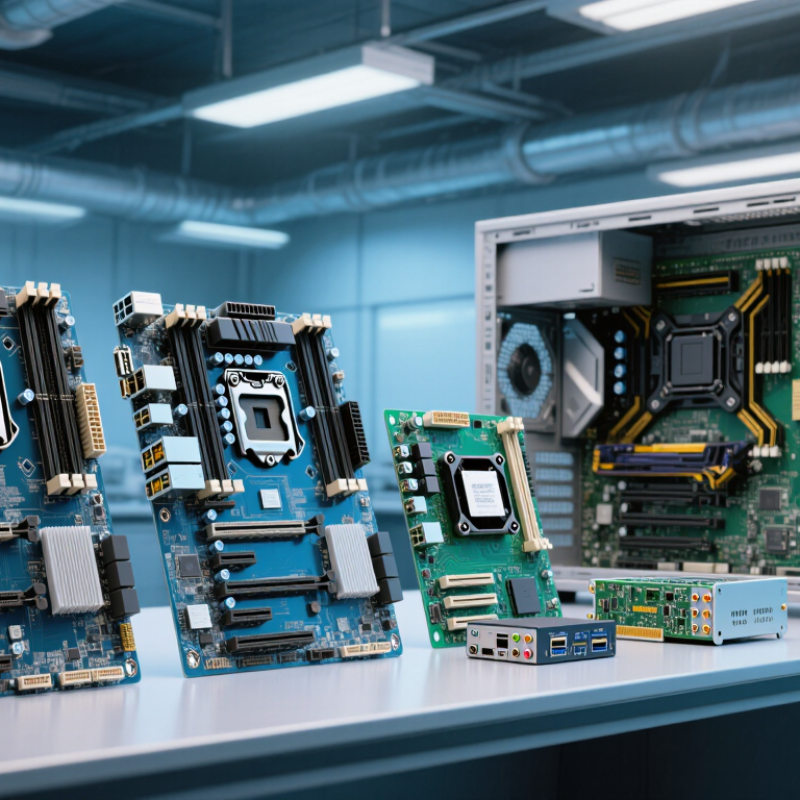
2026 Top Industrial Motherboard Types for Global Buyers?

What Is an Industrial Motherboard and Why Does It Matter?

An industrial motherboard is the control foundation of an industrial computer. It connects the processor, memory, storage, displays, sensors, and expansion cards. Unlike a consumer board, it supports continuous operation, wider temperature ranges, vibration resistance, and longer product availability. These features matter because replacing a failed board can stop a production line. MarketsandMarkets estimated the industrial PC market at about USD 5.8 billion in 2023. It projects the market to reach nearly USD 8.5 billion by 2028.

Global buyers will see several practical motherboard types in 2026. ATX and Micro-ATX boards offer generous expansion for machine vision, motion control, and data acquisition. Mini-ITX boards save cabinet space. Single-board computers suit compact gateways and remote monitoring. Computer-on-Module designs provide flexibility when processors or interfaces change. IDC’s Worldwide Edge Spending Guide has forecast strong growth in edge computing investment through 2028. That trend increases demand for reliable local processing. Still, more interfaces do not always mean better value. Some projects buy excessive capacity, then face higher heat and maintenance costs. This deserves honest review.

Tips: Match the board to actual workloads, not marketing claims. Check operating temperature, lifecycle commitments, storage support, remote management, and tested memory compatibility. Request validation records for vibration and thermal testing. A three-year warranty helps, but documented field support matters more.

How Industrial Motherboards Are Classified by Form Factor

In 2026, industrial motherboards are classified mainly by form factor, not processor speed alone. The size determines enclosure fit, mounting points, expansion space, and cooling options. Standard ATX boards suit control cabinets needing multiple PCIe slots, storage devices, and network interfaces. MicroATX reduces cabinet volume while retaining practical expansion. Mini-ITX fits compact machines, but limited slots may restrict future upgrades.

Smaller embedded systems often use 3.5-inch single-board computers or customized boards. These designs support narrow enclosures, fanless cooling, and direct I/O connections. Computer-on-module solutions separate the processor module from the carrier board, helping engineers adapt one platform across several machines. Mechanical drawings must be checked carefully. A board can match the advertised size yet fail because of connector height or misplaced standoffs. I have seen this issue delay installation more often than expected.

Tips: Confirm board dimensions, hole positions, connector clearance, and cable direction before ordering. Check operating temperature, power input tolerance, lifecycle data, and available technical documents. For dusty factory floors, passive cooling may appear safer, but heat can accumulate inside sealed cabinets. A larger board with better airflow may prove more reliable. Still, every application differs. Leave room for maintenance, even when cabinet space seems expensive.

Key Industrial Motherboard Types for Global Buyers in 2026

Key Industrial Motherboard Types for Global Buyers in 2026

Industrial buyers in 2026 can choose from ATX, MicroATX, Mini-ITX, embedded, and single-board designs. Each type supports different space, expansion, and maintenance needs. ATX boards suit factory computers requiring several PCIe slots, storage devices, and network cards. MicroATX offers similar flexibility in smaller control cabinets. Mini-ITX works well where panel space is limited. Compact, but not always sufficient.

Embedded and fanless motherboards are practical for kiosks, machine vision, transportation controls, and outdoor monitoring units. They reduce moving parts and dust exposure. However, fanless systems may throttle under continuous high loads. Single-board computers simplify installation and reduce cable connections, but their expansion options can be narrow. Buyers should check processor longevity, operating temperature, shock resistance, memory support, and available I/O before approval. A prototype test often reveals weaknesses hidden in a specification sheet.

Tips: Match the board to the enclosure first. Measure mounting holes, airflow paths, connector clearance, and cable bending space. Request a lifecycle statement and documented testing conditions from the supplier. Verify regional power requirements and required certifications with qualified professionals. Keep a replacement plan. A low purchase price can become expensive when a custom board reaches end-of-life early.

How to Match Motherboard Features with Industrial Applications

2026 Top Industrial Motherboard Types for Global Buyers

How to Match Motherboard Features with Industrial Applications

Industrial motherboard selection should begin with the machine, not the processor. Factory controllers often need stable I/O, extended temperature support, and long product availability. A compact Mini-ITX design suits space-limited inspection equipment and small robotic cells. Larger ATX or industrial backplane boards provide more expansion for motion cards, data acquisition, and multiple network interfaces.

Edge vision systems require strong graphics processing, fast storage, and reliable memory. However, excessive computing power can increase heat, power use, and maintenance demands. Check the enclosure airflow before choosing a high-performance platform. For outdoor cabinets, wide-voltage input, conformal protection, and vibration resistance matter more than benchmark scores. Small details matter.

Transportation equipment needs secure boot, watchdog control, isolated interfaces, and reliable operation during vibration. Fanless designs can reduce dust problems, but passive cooling may limit sustained performance. This trade-off is easy to underestimate. In medical and laboratory equipment, predictable operation, traceable components, and controlled interfaces deserve close attention. Confirm applicable regional requirements with qualified compliance specialists.

Global buyers should also examine USB, serial, LAN, display, and storage connections against the actual wiring plan. A missing legacy port can force an expensive redesign. Remote monitoring may reduce service visits, especially across multiple sites. Still, network access must be configured securely and reviewed regularly. Even experienced teams sometimes select a board from a data sheet alone. Field conditions usually expose the weakness. Test the complete motherboard, enclosure, operating system, and power supply together before volume deployment.

2026 Top Industrial Motherboard Types for Global Buyers

How to Match Motherboard Features with Industrial Applications

The 1–5 scores represent a comparative engineering assessment based on commonly available characteristics of industrial motherboard categories, including expansion capacity, compactness, ruggedness, power efficiency, and long-term deployment suitability. Higher scores indicate a stronger fit for the application.

What Global Buyers Should Check Before Making a Purchase

The 2026 industrial motherboard market will favor ATX, Mini-ITX, COM Express, and single-board designs. According to MarketsandMarkets’ Industrial PC Market report, the sector is projected to grow at roughly 7% annually through 2029. Growth does not make every board suitable for factory duty. Buyers should match the form factor with enclosure space, expansion needs, and service access.

Check the processor lifecycle and planned availability before approving a design. A low purchase price means little if replacement boards disappear after two years. Review operating-temperature ratings, vibration testing, power-input tolerance, and thermal airflow with measured data. IEC 60068 test methods can help compare environmental claims, but certificates should be verified, not assumed. Industrial environments are rarely clean.

Connectivity deserves close attention. Count native Ethernet ports, serial interfaces, USB channels, display outputs, storage sockets, and expansion lanes. Then confirm their simultaneous operation. A board may advertise many ports, yet share bandwidth internally. That detail can disrupt cameras, controllers, or data logging. The 2024 IPC Global Sentiment of the Electronics Industry Report identified continuing supply-chain and demand uncertainty across electronics manufacturing. Keep approved alternatives for memory, storage, and power components. It is not elegant, but it reduces dependence on one configuration. Ask for BIOS update procedures, long-term support terms, failure-analysis response times, and traceable test records. A spreadsheet can still lie. Test a sample under real heat, dust, vibration, and cable loads before placing a global order.

2026 Top Industrial Motherboard Types for Global Buyers? - What Global Buyers Should Check Before Making a Purchase

Motherboard Type Typical Standard Size Expansion and I/O Characteristics Typical Industrial Applications Key Strengths Main Limitations What Global Buyers Should Check
ATX Industrial Motherboard 305 × 244 mm Up to seven expansion-slot positions in the ATX layout; commonly supports PCI Express, multiple SATA interfaces, USB, Ethernet, and industrial I/O options depending on the design. Industrial automation, machine vision, factory control cabinets, digital signage, network appliances, and general-purpose industrial computers. Large PCB area, broad expansion capability, easy component access, and wide availability of standard chassis and power supplies. Larger enclosure requirement and usually higher power and cooling requirements than compact form factors. Confirm exact slot arrangement, PCIe lane allocation, operating-temperature rating, 24-pin power compatibility, mounting-hole pattern, and chassis clearance.
MicroATX Industrial Motherboard 244 × 244 mm Up to four expansion-slot positions in the standard layout; normally provides PCI Express, SATA, USB, Ethernet, and display interfaces according to the model. Compact automation controllers, industrial PCs, transportation systems, inspection equipment, and embedded server applications. Balances expansion capability and enclosure size while retaining compatibility with many ATX-based system components. Fewer expansion positions than ATX; slot spacing can be restrictive when using large add-in cards. Check whether the selected chassis supports the board mounting points, whether adjacent slots remain usable, and whether the power supply provides sufficient continuous output.
Mini-ITX Industrial Motherboard 170 × 170 mm One standard expansion-slot position; frequently integrates dual Ethernet, serial ports, USB, display outputs, GPIO, storage interfaces, and optional wireless or cellular connectivity. Edge computing, kiosks, compact controllers, robotics, in-vehicle systems, portable test equipment, and space-constrained automation devices. Very small footprint, low power consumption potential, and straightforward integration into compact enclosures. Limited expansion, reduced heat-spreader area, and less room for connectors or removable storage. Verify processor thermal design power, heat-sink height, connector orientation, memory type, DC-input range, vibration resistance, and long-term availability.
3.5-Inch Single-Board Computer Approximately 146 × 102 mm Usually relies on integrated I/O, board-to-board connectors, mini PCI Express, M.2, or other compact expansion interfaces rather than full-size PCIe slots. Industrial gateways, HMI terminals, medical instruments, smart retail equipment, factory data collection, and embedded control systems. Compact design, low power demand, integrated peripheral interfaces, and flexible mounting options. Limited full-size expansion and often lower maximum memory or storage capacity than larger boards. Check the exact board outline, mounting-hole coordinates, connector access, BIOS or firmware support, watchdog features, and availability of Linux or Windows drivers.
COM Express Computer-on-Module Compact: 95 × 95 mm
Basic: 125 × 95 mm
Processor, chipset, memory, and high-speed interfaces are placed on a removable module; a separate carrier board provides application-specific I/O. Modular industrial computers, medical devices, robotics, transportation electronics, machine vision, and products requiring processor scalability. Enables processor upgrades without redesigning the complete carrier board and supports customized system I/O. Requires a compatible carrier board, connector design, thermal solution, and careful high-speed signal layout. Confirm COM Express pinout type, module revision, carrier-board compatibility, connector stack height, thermal design, BIOS support, and migration options for future processors.
PICMG 1.3 System Host Board Approximately 338.58 × 126.39 mm Designed for a passive backplane system; provides a host processor interface to PCI Express, PCI, and other backplane resources according to the implementation. Industrial rack systems, factory automation, legacy PCI-based equipment, data acquisition, and multi-slot control systems. Centralized backplane architecture, serviceable slot-based expansion, and suitability for systems requiring several plug-in modules. Depends heavily on backplane design and may be less suitable for very compact or low-power products. Validate the exact PICMG 1.3 backplane pinout, supported PCIe generation, slot bifurcation, processor cooling, rear I/O arrangement, and legacy-card compatibility.
3U VPX Embedded Computing Board 100 × 160 mm Uses a rugged backplane architecture with high-speed serial fabric connections; commonly configured with PCI Express, Ethernet, or other application-specific fabrics. Defense and aerospace systems, rugged transportation, radar processing, high-performance image processing, and mission-critical edge computing. High mechanical ruggedness, strong signal integrity, high-speed backplane connectivity, and support for harsh environments. Higher system cost, specialized chassis and backplane requirements, and greater integration complexity. Check VPX profile and slot compatibility, backplane fabric topology, conduction- or air-cooling method, shock and vibration ratings, environmental qualification, and power budget.
6U VPX Embedded Computing Board 233.35 × 160 mm Provides more board area and connector capacity than 3U VPX; supports complex processing, storage, I/O, and high-speed backplane configurations. High-performance defense electronics, avionics, radar, electronic warfare, industrial simulation, and large-scale rugged computing platforms. Greater processing, I/O, and power capacity for demanding embedded applications. Large and costly system architecture with higher enclosure, power, and thermal-management requirements. Confirm slot pitch, power-interface specification, cooling method, backplane topology, environmental compliance, system weight, and maintenance access.
Industrial SBC with Custom Backplane Application-specific; commonly based on a defined Eurocard or custom PCB outline Uses a dedicated backplane or carrier to expose selected PCIe, Ethernet, serial, digital I/O, storage, and synchronization interfaces. Specialized inspection systems, telecommunications, transportation control, laboratory instruments, and long-life OEM equipment. Highly optimized electrical, mechanical, and I/O design for a specific system architecture. Higher non-recurring engineering cost and reduced interchangeability with off-the-shelf platforms. Review mechanical drawings, connector mating cycles, signal-integrity requirements, firmware ownership, minimum order quantities, redesign charges, and spare-part policy.

Dimensions shown are recognized form-factor references; actual products may vary in connector placement, mounting holes, height, power input, thermal solution, and environmental rating. Buyers should request the latest mechanical drawing, electrical specification, lifecycle statement, compliance documentation, and sample test results before purchase.

MSIRobot